How to Chase Vendor Final Details Forms Without Becoming the Vendor's Reminder Service
2 November 2026 · 6 min read
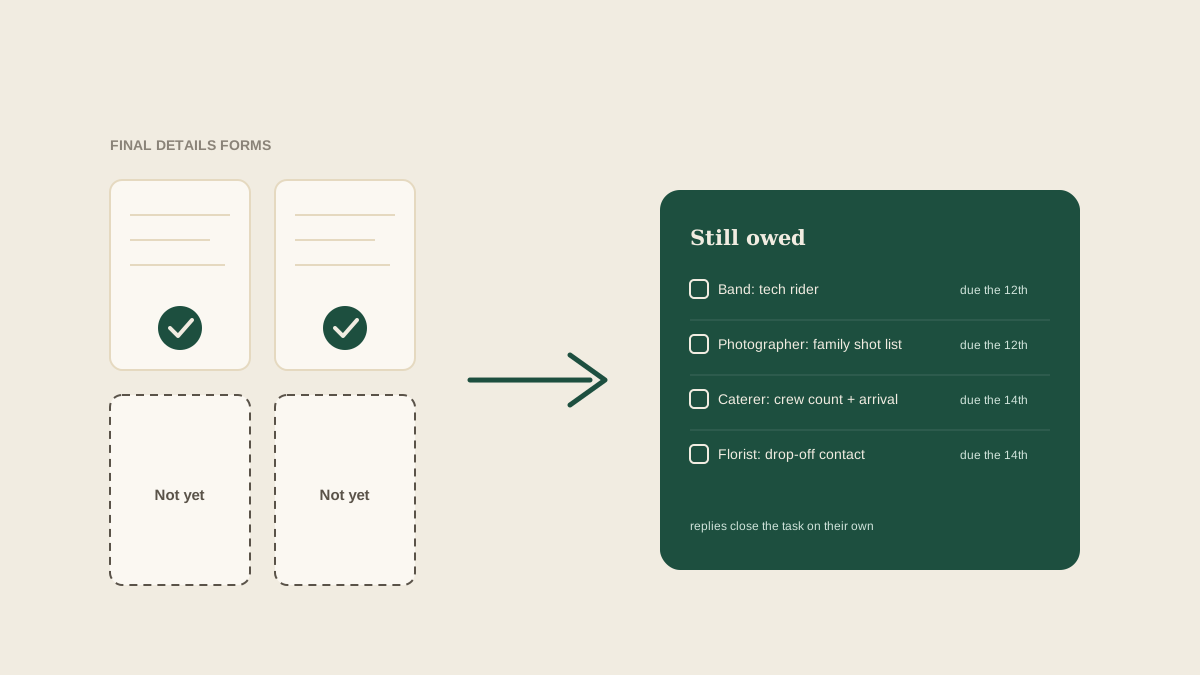
A few weeks before the wedding, a planner asks each vendor for a final details form. The caterer sends their service plan. The band sends a tech rider and a song list. The photographer sends a shot list for the family portraits. The florist confirms a drop-off contact. Each form is small. Together they decide whether the day runs smoothly.
The trouble is that the forms are not due all at once, and they do not all come back on time. Some arrive in a day. Some arrive after three reminders. Some arrive as a phone photo of a handwritten page. And the studio is left running a quiet chase operation across eight vendors per wedding, multiplied by every wedding in the season.
The aim is not to be more insistent. It is to know, at any moment, exactly which forms are still owed, and to make the follow-up almost automatic. Here is how.
Start with a clear list of what is owed
Before sending a single request, write down which forms each vendor owes. It is tempting to ask for "final details" in general terms. Vague requests produce vague returns, and you cannot track what you never defined.
For each vendor, name the specific pieces: arrival time and crew count, contact on the day, setup needs, special requests, and anything the venue requires. A named list gives you a yes or no on each piece, instead of an arguable feeling that the vendor "sent something".
Give every request a due date that works backward
A due date set at the last minute guarantees a scramble. Work backward from the wedding: when does the studio need each form in order to build the day-of timeline, brief the venue, and still have time to fix any gaps?
Usually the answer is earlier than vendors expect, and that is fine, as long as you say why. "I need your final details by the 12th so the timeline can go to the venue on the 15th" gets a faster reply than "please send by two weeks before".
Make each request a task, not a message
A request in an email thread is easy to forget. A task with a name, a due date and a vendor attached is hard to forget. When you ask the band for their tech rider, that request should exist as an open item on the wedding's board, assigned to whoever is following up.
Let the replies close the tasks
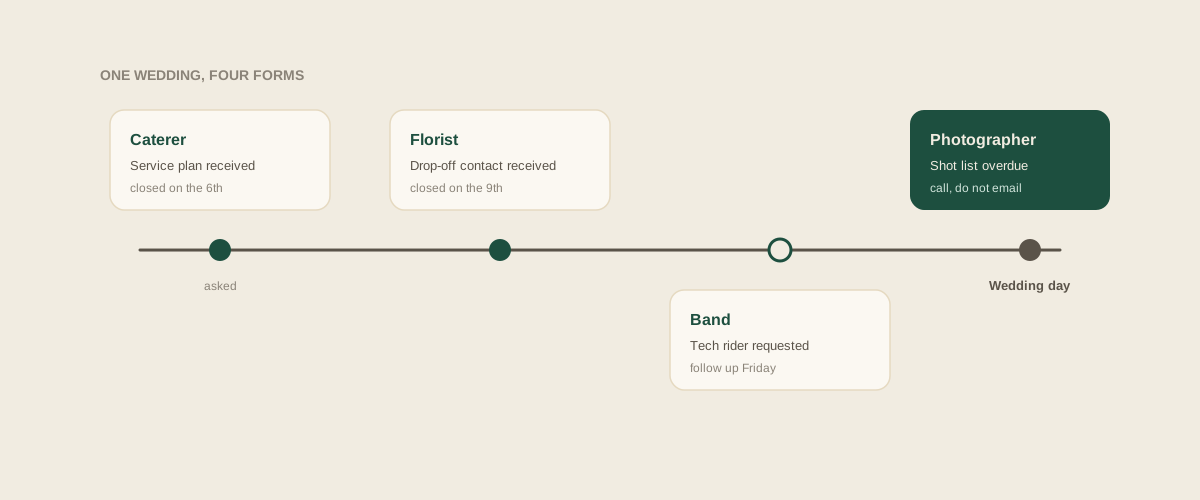
The reply is where most tracking falls apart. A form arrives as an attachment in one person's inbox, a short answer comes by text, and the task stays open because nobody updated it. Now the board says the vendor owes a form they sent last week, and a second reminder goes out that annoys everyone.
Glaard reads what you forward to your studio address, including attachments and screenshots of text messages, and matches the reply to the right wedding and the right open request. The form is attached to the task, the task closes, and the board reflects reality without anyone retyping a status.
Follow up in one batch, not eight nudges
Once the board shows what is outstanding, follow-ups become a single routine instead of a series of interruptions. Set a regular time, say Tuesday and Friday mornings, to look at overdue forms across your weddings and send the reminders together.
A reminder works best when it is specific: "We are still missing your crew count and arrival time. Could you send both by Thursday?" That is easier to answer than "just checking in", and it gives you something concrete to attach when the reply comes.
Escalate to a different person, not a louder message
When a vendor has missed two reminders, a third email rarely helps. Try a different route: a short phone call, a text to the person who will actually be on site, or a note to the vendor's office manager. Record who you contacted and what they said, so the next person covering the wedding does not repeat the same chase.
Know what you can proceed without
Not every missing form blocks the day. Decide in advance which items are essential (arrival time, on-site contact) and which are nice to have (a favorite playlist). If an essential form is still missing a week out, make it a priority task. If a nice-to-have is missing, note it and move on.
Where to start
Take the wedding that is closest. List every form each vendor owes, add a due date for each, and mark which are received. Then pick one regular follow-up slot per week. A few weeks of that rhythm will do more than any single heroic week of chasing.
Frequently asked questions
How early should final details forms be due?
Work backward from when you need to share the day-of timeline with the venue and the rest of the team, and leave a week for gaps. For most weddings that means two to three weeks before the date.
What if a vendor keeps ignoring reminders?
Change the channel instead of repeating the message. Call, text the person who will be on site, or contact the vendor's office. Log who you reached and what they said so the next person does not start over.
Which details are essential and which can wait?
Arrival time, crew count, setup needs and an on-site contact are essential. Preferences like song lists or small styling notes matter, but they should not hold up the timeline.
How does Glaard help track vendor forms?
Forward the vendor's reply, attachment or text screenshot to your studio address. Glaard matches it to the right wedding, closes the open request and keeps the original message attached, so the shared board shows what is still owed.
Get your studio address, free
Get your studio address
