4 Ways Studios Get a Client's Must-Have Lists (Shot List, Song List, Do-Not-Play) to the Right Vendor (And Where One List Never Arrives)
20 October 2026 · 6 min read
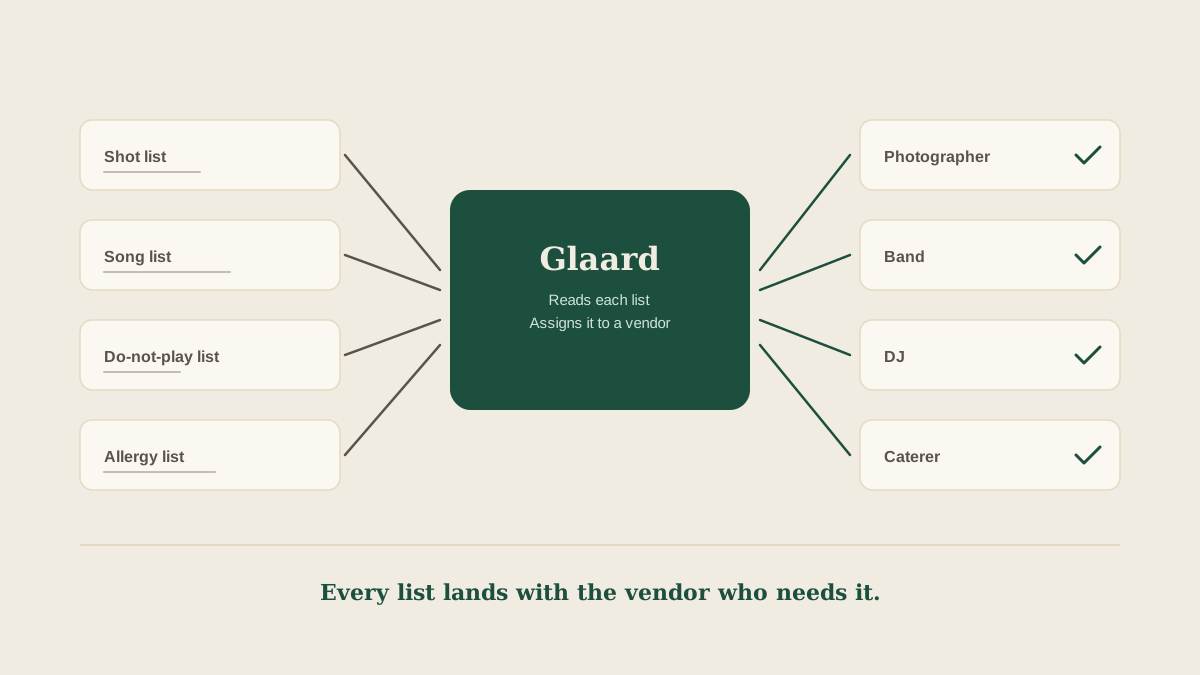
Every couple has a handful of lists that matter far more than their size suggests. The family photos the photographer must get. The songs the band should play and the three it must never play. The guest with a tree nut allergy the caterer needs to hear about in writing. Each list is short, and each one is the kind of detail a client remembers for years if it goes wrong.
The problem is not writing the lists. Clients do that happily. The problem is that they arrive in whatever form the client felt like that day: a note typed into a phone, a photo of a handwritten page, a long text sent at 11 PM, a link to a shared playlist, a reply buried at the bottom of an email about something else. Then someone has to get each list to the one vendor who needs it. Here are four ways studios do that, and where each one still loses a list.
1. Forward each list to the vendor as it arrives
The most direct method is to forward the client's message to the right vendor the moment it lands. It is fast, and the vendor gets the client's own words with nothing lost in translation.
It works until the list changes, which it always does. The client sends a shot list on Monday and an amended one on Thursday, and the photographer now has two versions with no indication of which wins. Forwarding also leaves no record on the studio's side of who received what, so when the photographer says they never got the list, nobody can say for sure. And a list that arrives while the planner is on a site visit sits unforwarded until the end of the day, or the end of the week.
2. Collect everything in one master document
Some studios keep one shared document per wedding with a section for each vendor: photo list here, music here, dietary needs there. The planner pastes each list in and sends the vendor a link.
A single document is a good instinct, but it depends on someone doing the pasting. A client text sits in the planner's phone until they have a quiet hour to transcribe it, and a photographed handwritten list has to be retyped by hand. During a busy week that quiet hour does not come. The document also quietly goes out of date, because a vendor who opened the link in June is not told about the change made in August. Nobody gets an alert when a section is edited, so the vendor works from what they last read.
3. Ask the client to send lists directly to each vendor
To cut out the middle step, some planners tell clients to email the photographer and the band themselves. It saves the studio time and puts the client in direct contact with the people doing the work.
In practice it creates two blind spots. The studio no longer knows what was sent, so a list can be wrong or missing and nobody on the team will notice. And clients are inconsistent. One sends the song list to the band, the do-not-play list to the DJ, and forgets the band is a separate act from the DJ. When the vendor then reads the list differently from what the client meant, the planner finds out on the wedding day, not three weeks before.
4. Forward everything to the studio first, and let it become tasks
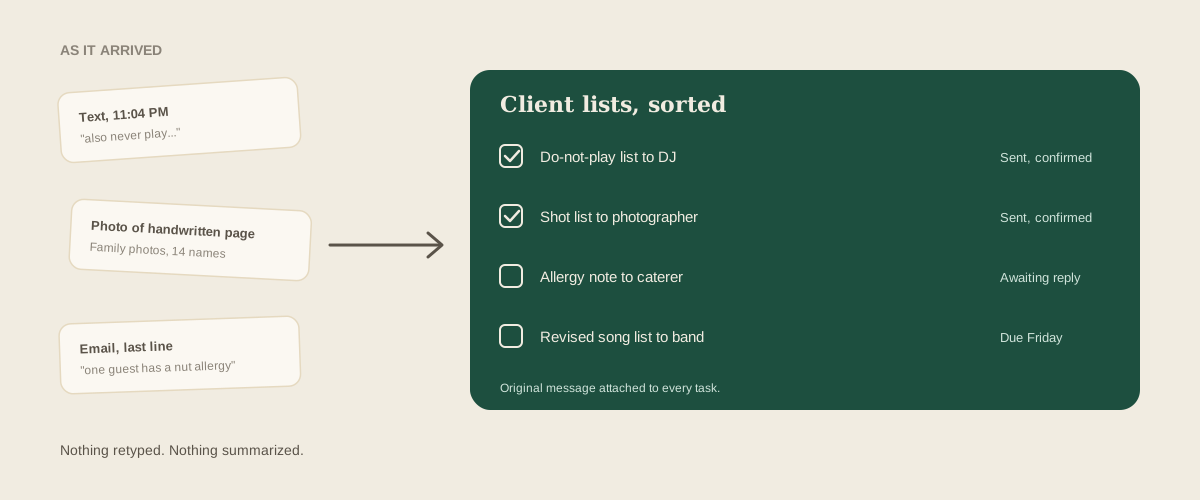
The fourth approach routes every client list through one place before it reaches a vendor. The client's message, photo, or email gets forwarded exactly as it arrived to the studio's shared Glaard address. Glaard reads it, works out which wedding it belongs to and which vendor needs it, and puts a task on the shared board: send updated shot list to the photographer, with the client's original message attached.
The difference is that the list now has an owner, a date, and a status. A coordinator sees send shot list to photographer, due Friday, and takes it. When the client sends a revised version, it shows up as a new task referencing the earlier one, so the board makes the replacement visible instead of leaving two versions in circulation. Nobody retypes a handwritten photo, and nobody summarizes a long text in their own words and risks dropping the line that mattered.
This approach has limits too. Glaard captures what gets forwarded, so a list read aloud over the phone still needs someone to note it and send it on. And a task being marked sent does not prove the vendor read it. For lists where the consequence is serious, like allergies, ask the vendor to confirm receipt in a reply, and forward that reply to the studio address so the confirmation lives on the board next to the list.
What to check on each list
Whatever method you use, three questions are worth asking about every client list. Which vendor owns it? Is this the latest version? And has that vendor confirmed they have it? A list that cannot answer all three is a list that might fail on the day.
Dates matter here too. Ask vendors when they need each list by. A band often wants the song list weeks ahead to prepare, while a photographer may be happy with a shot list a few days before. Put that deadline on the task so the client request goes out early enough to be useful.
Where to start
Pick the wedding coming up next and list every client list you have received so far. Next to each one, write the vendor who needs it and whether they have confirmed. Any blank in that second column is a list that could still be sitting in a phone. Forward those messages to your shared address today and see which ones turn into open tasks.
Frequently asked questions
Which client lists should go to vendors in writing?
Anything a vendor could get wrong in a way the client would notice: shot lists, song and do-not-play lists, dietary and allergy details, seating or VIP names, and special instructions for the ceremony. If it matters to the client, it should be sent in writing and confirmed.
What if a client sends a list as a photo of a handwritten page?
Forward the photo as it is to your studio address. Glaard reads the image and pulls out the task, with the original attached so a coordinator can check the exact wording. There is no need to retype it first.
How do we handle a client who keeps revising a list?
Treat each revision as its own task that replaces the last one, and tell the vendor which version is current. Keeping the earlier messages attached lets you show the vendor exactly what changed and when.
Should allergy information go through the studio or straight to the caterer?
Both. Send it to the caterer, and also keep it on the board with a task to get written confirmation back. Having the caterer's reply next to the original request is the record you want if anything is questioned later.
Get your studio address, free
Get your studio address
