What Happens to Event Coordination When the Lead Planner Is Out (4 Common Backups, and Where Each Fails)
3 August 2026 · 7 min read

Every studio that runs on one lead planner tracking most of the vendor logistics eventually has a day that tests it: a trip, an illness, a flight delay, a day with no signal. The caterer still needs a headcount, a deposit is still due, someone still has to confirm the delivery window at the right time. What actually happens on that day says more about a studio's system than any ordinary week does, because it's the one moment the person holding everything in their head isn't available to answer a question.
The verbal handoff
The most common backup is a quick briefing before the planner leaves: "the florist delivers at 9, don't forget the final payment is due Friday, the caterer needs the headcount by Wednesday." It works for the handful of things top of mind at that exact moment. It doesn't work for the smaller items that live only in that planner's memory and never come up in a two minute conversation on the way out the door: the deposit due next week, the rental company that needs a callback, the delivery window that was changed last month. A verbal handoff is only as complete as what the departing planner happens to remember to say, under time pressure, usually while also finishing packing.
The shared tracker as a safety net
Many studios point to their shared tracker or CRM as the answer: if it's not written down, it doesn't exist, and if it's written down, anyone can see it. This genuinely helps for deadlines that made it into the tracker in the first place. The gap is the same one that shows up on an ordinary week: a tracker only contains what someone took the time to type into it, and a lot of vendor logistics never makes it that far, a group chat message about an early delivery, a contract term that needs a decision rather than a date, a text from a vendor about a location change sent that same morning. The tracker covers what was already captured. It has nothing to say about what was still sitting in one planner's inbox or head when they left.
The notebook or shared doc
Some studios keep a running notebook or shared document specifically for this: a running list of what's going on that week so anyone can catch up. It's more complete than a quick verbal handoff because it's written down over time rather than recalled under pressure. The catch is that it only stays useful if someone updates it consistently, which is itself another task competing with everything else that planner is already tracking. In practice, the notebook is often accurate for the first week it exists and quietly stops being updated a month later, right around the time it's needed most.
Just wait it out
The most common approach, honestly, is none of the above: the studio just manages for a day or two with some things slipping, a missed confirmation, a scramble on delivery day, an apology call to a vendor, and life goes back to normal once the lead planner is back. This isn't really a plan, it's the absence of one, but it's worth naming because it's what a lot of studios actually do, and it works often enough that many never build anything more deliberate, right up until the day something that slips actually matters: a missed deposit deadline, a forgotten confirmation, a booking that closes for good.
Why every backup still depends on the same person's memory
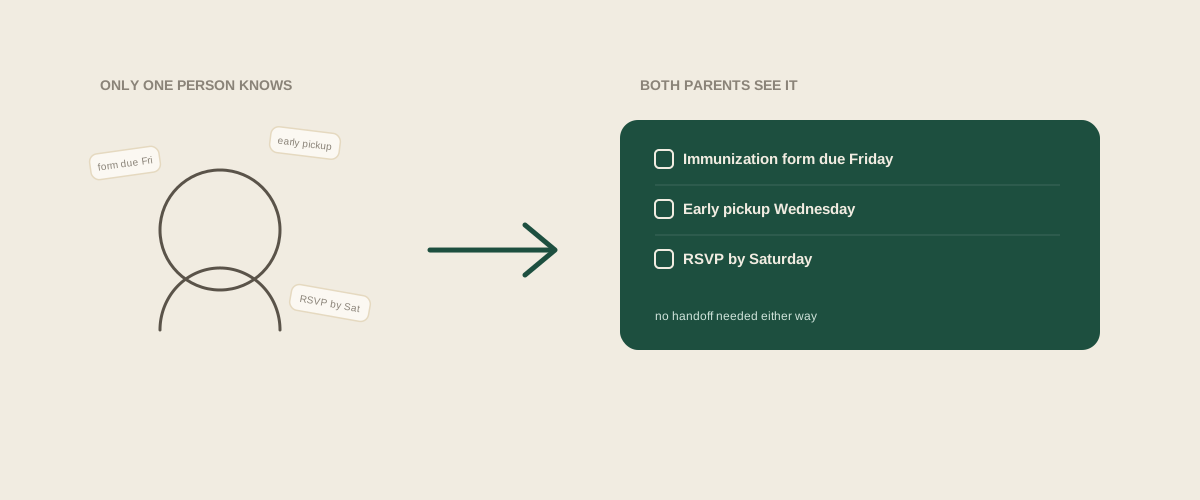
Look closely at all four and they share the same weakness: each one is really just a different way of getting information out of one planner's head, whether that's a rushed conversation, a tracker they remember to update, or a notebook they remember to keep current. None of them change where the information originates. If one planner is still the only one reading every vendor email, every group chat, and every contract during a normal week, no backup plan built on top of that changes what happens the day they're unreachable, it just determines how much of what they knew gets transferred before they go.
What actually removes the single point of failure
The actual fix has to happen earlier than the handoff: if incoming information gets pulled out and placed on a shared board the moment it arrives, whoever forwarded the vendor email or the coordinator's text, rather than sitting with one planner until they choose to pass it along, then there's no single point of failure to work around in the first place. Any team member can see the same board on the day the other one is out, not because of a briefing that happened that morning, but because the information was never gated behind one person's attention to begin with.
How to choose
A verbal handoff or a quick tracker check is fine for a studio whose event load is genuinely light, one event at a time, not much volume. It gets riskier the more concurrent events and vendors are involved, because the amount that has to be transferred in a rushed conversation grows every season while the time available for that conversation doesn't. The studios that stop worrying about the day the lead planner is out are usually the ones where the shared board was already complete before that day started, not the ones with the best handoff routine for when it happens.
Frequently asked questions
What is the fastest way to check if my studio actually has this single point of failure problem?
Try a real test: have another coordinator open the shared tracker or board on an ordinary day and see how much of what is actually happening that week they can find without asking. If most of it is missing, the studio mainly depends on one person's memory rather than a shared, complete record.
Isn't a good notebook or shared doc basically the same as an automated shared board?
Not quite. A notebook depends on someone remembering to write in it consistently, which is its own ongoing task. A shared board that fills in from forwarded messages does not need anyone to remember a separate update step, the information lands on it the same way it would have reached whichever planner read the message first.
Does this only matter for genuine emergencies, like illness or travel?
No, it matters just as much on ordinary days when the lead planner happens to be busy, in client meetings, or simply not the one checking messages that particular afternoon. The single point of failure shows up any time another coordinator needs information and the person who has it is not immediately reachable, which is far more common than an actual emergency.
Can multiple coordinators forward things without creating duplicate or conflicting tasks?
Yes, as long as the shared board is the same one every coordinator forwards into and checks, duplicate entries are easy to notice and merge, which is a much smaller problem than the alternative of several separate, incomplete pictures of what is going on.
Get your studio address, free
Get your studio address