How to Get Guest Allergy and Dietary Notes to the Caterer Without Anything Getting Lost
26 October 2026 · 6 min read
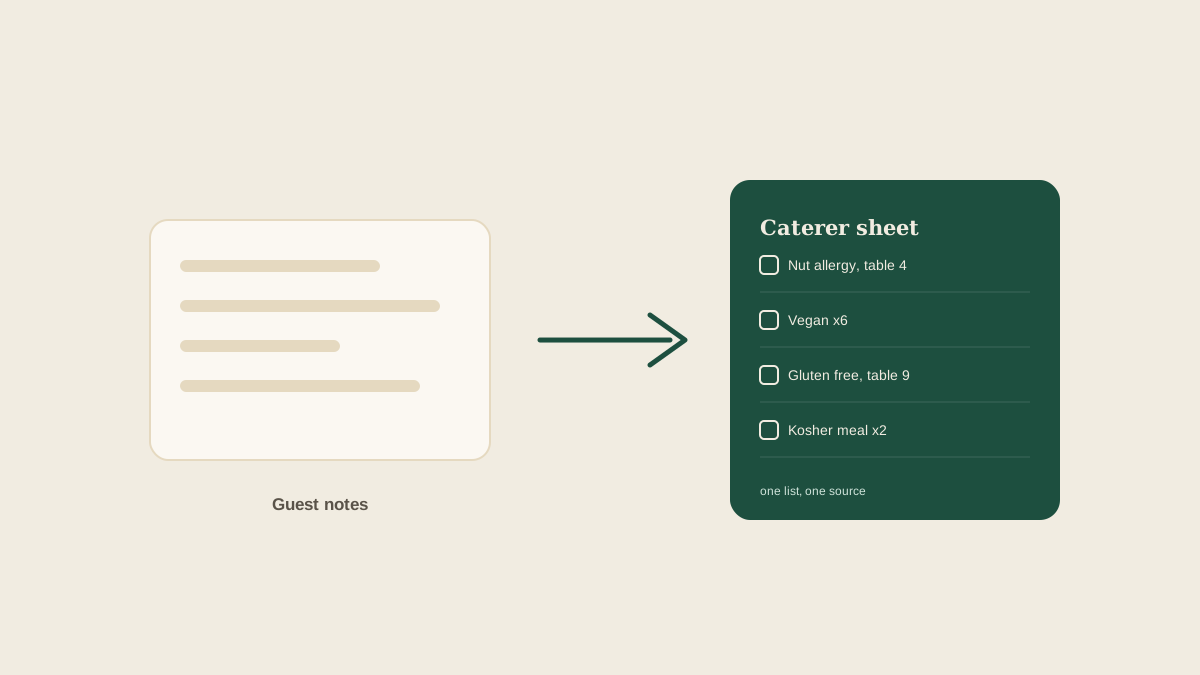
Of all the details a studio passes to vendors, the dietary ones carry the highest stakes. A late arrival is an annoyance. A missed shellfish allergy is a medical emergency. And yet these notes travel through more hands than almost any other piece of information in a wedding.
They start on RSVP cards, a website form, or a text from the bride's aunt. They pass through the couple, then the planner, then maybe a coordinator, and finally reach a caterer who has to turn them into plates on the right tables. Every handoff is a chance for one line to disappear. Here is how the information usually moves, and how to make the trail harder to break.
Why dietary notes get lost so easily
The first reason is that they arrive in the wrong shape. A guest writes 'no tree nuts, and my husband is vegetarian' in the margin of a response card. A parent mentions a child with celiac disease in a voicemail. A couple adds three names to a spreadsheet tab nobody else has open. None of these is a task. Each one is a fragment that someone has to notice and turn into an instruction.
The second reason is timing. Dietary details trickle in right up to the final headcount deadline, and then a few arrive after it. The caterer's list is only as current as the last time someone sent it, and the planner often has no clear way to tell which version the kitchen is cooking from.
The third reason is that the severity is invisible. 'Gluten free' might mean a preference or a medical need. A planner who forwards the note without that distinction leaves the kitchen guessing how careful to be.
Start with one place where every note lands
The most useful change is not a better form. It is a single destination. Whatever the source, a note should end up in one list for that wedding, with the guest's name, the table if known, the requirement, and whether it is an allergy or a preference.
For many studios that list is a spreadsheet, which works until a note comes in by text and the person holding the phone does not open the spreadsheet. The list is only trustworthy if getting something onto it takes almost no effort, because anything that takes effort gets postponed.
Mark severity in plain words
Write 'severe, carries an epinephrine pen' or 'preference, no pork' rather than a bare label. Caterers handle these very differently. A true allergy changes how a plate is prepared, which utensils are used, and who delivers it. A preference changes the menu choice. When severity is written down, the kitchen can plan, and nobody has to call the planner on the day to ask how seriously to take a line.
Send the caterer a written list and ask for a written reply
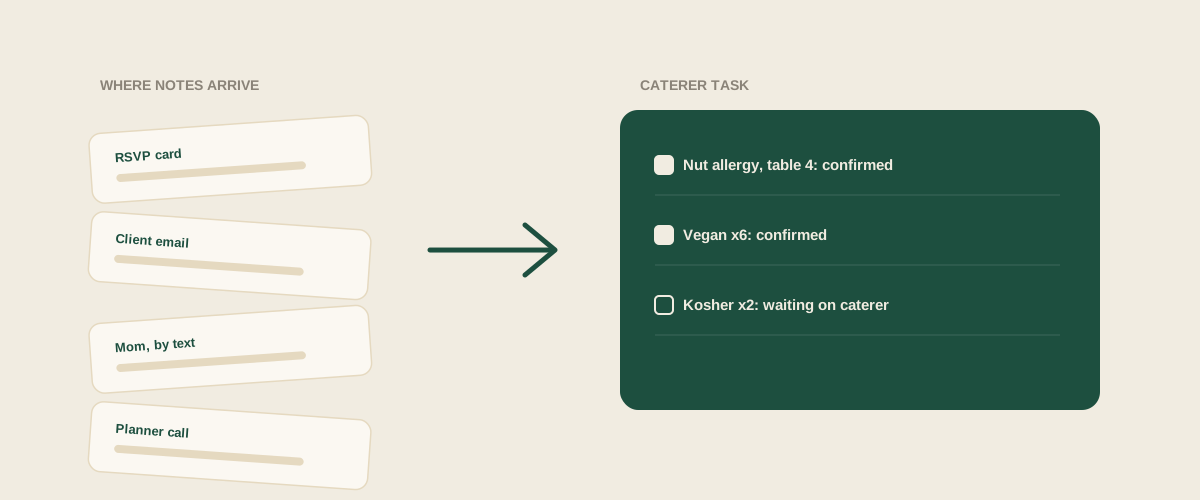
A phone call that covers the allergies feels thorough, but it leaves nothing to check against. Send the list in writing and ask the caterer to reply with each item acknowledged. That reply is the real record. It shows which requirements the kitchen has seen, and it exposes the one the caterer quietly cannot accommodate before the week of the event rather than during it.
The acknowledgment matters most for the unusual items. A kosher meal, a multi-allergen plate, a guest who needs a separate prep area. If the caterer has not answered a specific line, that line is still open, and it should look open to whoever is checking the board.
Keep one cutoff, and a way to handle what comes after it
Pick the date the dietary list freezes, usually at the final headcount deadline, and tell the couple what happens to notes that arrive later. Late notes are not rare. A guest remembers a new allergy, or a plus-one is added. If there is no rule, late changes get passed along informally, and informal is where they vanish.
A workable rule is that late notes are still accepted but go to the caterer as a clearly labeled addition, with a written confirmation requested, and the planner checks the confirmation the week before.
Plan for the guests who do not tell you
Some guests never mention a restriction until they sit down. It helps to agree with the caterer on a small buffer of vegetarian and gluten free plates, and to brief the servers on who to flag when a surprise comes up. Ask how the kitchen labels plates so that a server can tell a nut free plate from a standard one at a glance, and confirm that the servers have been told, not only the chef. A written list is only useful if the people carrying the plates have seen the relevant part of it.
Where Glaard fits
Glaard takes the messy part off the planner's plate. When a client email, a caterer reply, or a screenshot of a guest's text arrives, you forward it to your studio's shared address. Glaard reads it and puts the task on the wedding's shared board: 'Nut allergy, table 4, confirmed with caterer,' with the original message attached. A reply that does not clearly confirm an item shows as waiting.
It does not decide how severe an allergy is or what the kitchen can safely do. Those remain the planner's calls and the caterer's. What it removes is the retyping, and the risk that a note sat in one person's inbox because only they saw it.
Where to start
Pull the dietary and allergy notes for your next wedding from wherever they live. Count how many are in writing with the caterer's acknowledgment and how many exist only in someone's memory or a phone call. The second group is your risk.
Frequently asked questions
When should the dietary list be finalized for the caterer?
Most studios freeze it at the final headcount deadline set in the caterer contract, often seven to fourteen days before the event. Tell the couple in advance how late additions will be handled so they know to send them quickly.
How do we tell an allergy from a preference?
Ask for severity at the point of collection, and write it down in plain words, such as severe allergy, carries an epinephrine pen, or preference only. The kitchen can then prepare accordingly without having to guess.
Should the planner or the couple send dietary notes to the caterer?
Pick one sender per wedding and stick with it. Two people sending separate versions is how the caterer ends up with a list that conflicts with itself. Usually the planner sends one consolidated list and the couple sends additions to the planner.
How does Glaard help with dietary and allergy notes?
Forward client emails, caterer replies, and screenshots to your studio address. Glaard turns them into tasks on the shared wedding board, marked confirmed or waiting, with the original message attached, so nobody retypes them or loses one in a single inbox.
Get your studio address, free
Get your studio address
