How to Match a Vendor Email to the Right Wedding When the Subject Line Doesn't Say
19 October 2026 · 6 min read
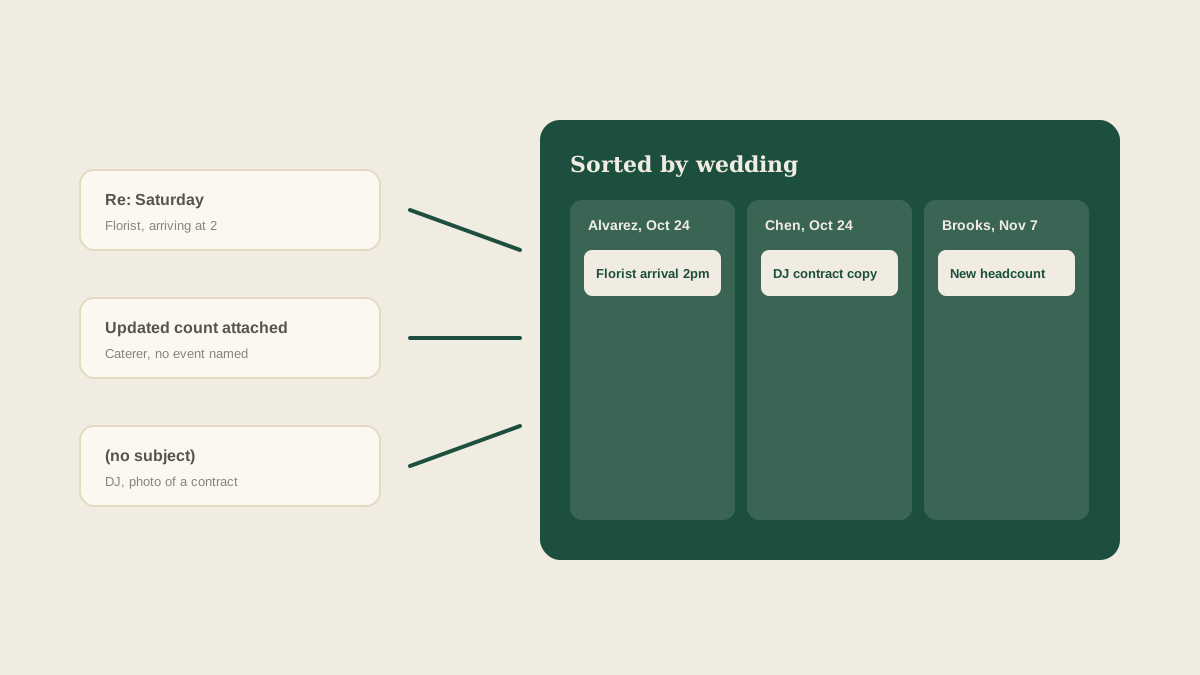
A florist writes, "Confirming Saturday, we will be there at 2." A caterer replies to a thread from March with, "Updated count attached." A DJ sends a photo of a contract with no message at all. If your studio runs more than a couple of weddings at once, every one of those emails raises the same quiet question: which wedding is this?
The person who knows is usually whoever has been living in that inbox. They glance at the sender, the venue name in a signature, the couple's first names in a quoted reply, and they just know. That works until that person is busy, away or new, and then a confirmation gets filed under the wrong event, or never filed at all.
Misfiled vendor email is a quiet kind of damage. Nothing explodes on the day it arrives. The problem shows up three weeks later, when a deposit looks unpaid, a headcount looks stale, or a vendor swears they sent the details to someone.
Why the subject line cannot be trusted
Vendors are not careless. They answer from their phones, reply to old threads, reuse a subject line across clients, and write "Saturday" because to them there is only one Saturday that matters. They also work with many planners, so they do not carry your internal naming system in their heads.
The result is that the clues for which wedding an email belongs to are scattered through the message rather than sitting in the subject. A date mentioned in passing, a venue name, a couple's surname in a quoted line, an attachment filename with a contract number. A person reads all of that in seconds. A rule based on the subject line reads none of it.
The clues that actually identify a wedding
Before choosing a method, it helps to list what you can match on. In rough order of reliability, studios tend to find these are the strongest signals:
The wedding date, especially when it appears together with a venue. The venue name or address. The couple's names, including surnames and any nickname the vendor uses. The vendor itself, if that vendor is only booked on one of your weddings in the relevant period. And finally the thread history, since a reply usually belongs wherever the original message did.
No single clue is perfect. A date can match two weddings on the same weekend. A vendor can be booked on three events. The point is that a good match uses several clues together and knows when it is not sure.
Four ways studios try to solve it, and where each strains
The first is the dedicated inbox per wedding. Each event gets its own address or label, and vendors are told to use it. This is tidy in theory, but vendors forget, reply to old addresses and mix events, so you still end up sorting by hand.
The second is the planner who just knows. It is fast and often right, which is exactly why it goes unnoticed. It also means the matching lives in one head, and every sick day or busy Saturday turns into a risk.
The third is a naming convention in subject lines, such as putting the couple's surname in brackets. It works for the emails you send and breaks for the ones you receive, because you cannot control how a vendor replies.
The fourth is a weekly cleanup session, where someone sweeps the inbox and files everything properly. This catches mistakes, but late, and it eats an hour that usually gets skipped in peak season.
What a better setup looks like
The goal is not perfect automatic sorting. It is sorting that is right most of the time and honest the rest of the time. That means three things.
First, forward everything to one studio address rather than trying to teach each vendor a new habit. You can forward from your own inbox, which means vendors keep writing exactly as they always have.
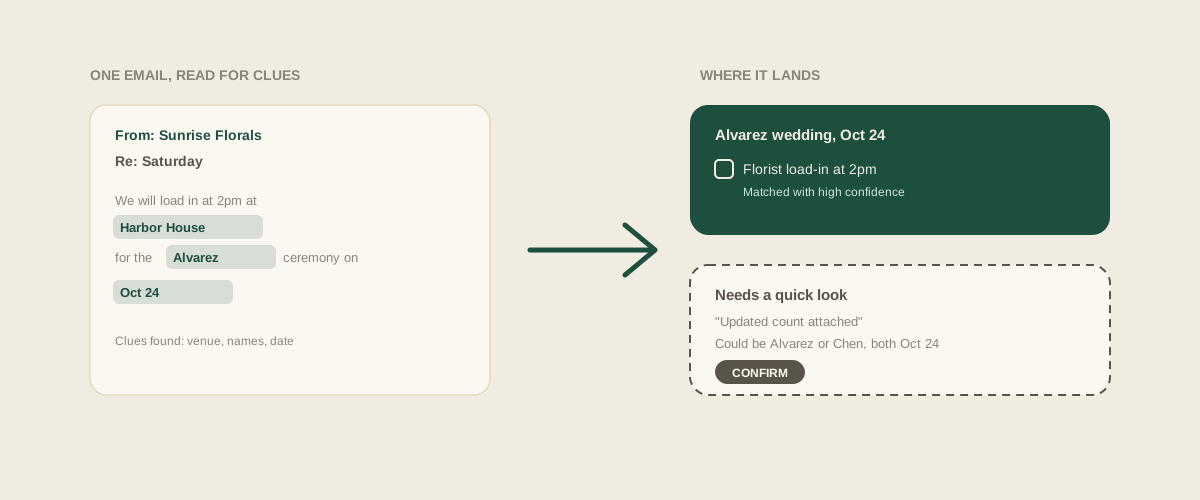
Second, read the whole message, not just the subject. Glaard does this when you forward an email to your studio address: it looks at the body, the attachments, the dates and the names, works out which wedding the message belongs to, and puts the resulting deadline, confirmation or question onto that wedding's board.
Third, make uncertainty visible. When an email could belong to two weddings, the right behavior is to flag it for a quick human decision rather than guess silently. A thirty-second tap to confirm is much cheaper than a wrong guess nobody notices.
Build a few habits around it
Whatever tool you use, a few small habits make matching easier for everyone. Ask vendors to include the date and venue in their first line, and say so once, in the booking confirmation, rather than repeating it. Keep one clear name for each wedding that the whole team uses, so that "the Alvarez wedding" never turns into three different labels.
When you send a vendor a question, include the wedding's date and venue in the message. Their reply will usually quote you, and that quoted text becomes the clue that anchors the match.
Check your matching once a month
Pick a random handful of recent vendor emails and trace each one to its wedding. Were they filed correctly? How long did it take? Did any sit unmatched? If one in ten is wrong or slow, that is the number to bring down.
You will probably find the mistakes cluster around the same situations: two weddings on one weekend, a vendor booked on several events, or a reply to a very old thread. Those are the cases to write down as rules, or to make sure get flagged for review.
A simple place to start
Take this week's vendor emails and, for each one, note the clue that told you which wedding it belonged to. You will see the pattern quickly, and it will show you what a system needs to read. Then forward the next batch to a single studio address and compare where each one lands. The first time it flags an ambiguous message instead of burying it, the value of the approach tends to be obvious.
Frequently asked questions
What if two weddings fall on the same weekend with the same vendor?
This is the hardest case, so it should be flagged for a quick human check rather than guessed. Adding the venue or the couple's names to your own outgoing messages gives the vendor's reply something to anchor on.
Should I ask vendors to put the couple's name in every subject line?
Ask once, in the booking confirmation, but do not rely on it. Vendors reply from phones and old threads, so a setup that reads the full message is more dependable than one that depends on their habits.
How does Glaard decide which wedding an email belongs to?
When you forward a message to your studio address, Glaard reads the body and attachments for dates, venue names, couple names and thread context, then places the resulting task on the matching wedding's board. Ambiguous messages are surfaced for a quick confirmation.
Is it worth fixing misfiled email if it only happens occasionally?
Yes, because the cost is not the filing. It is the deposit, headcount or confirmation that turns out to be wrong weeks later. Even a rare miss is expensive when it lands on a deadline.
Get your studio address, free
Get your studio address
