How to Stop Two Vendors From Being Scheduled Into the Same Loading Dock at Once
31 August 2026 · 6 min read
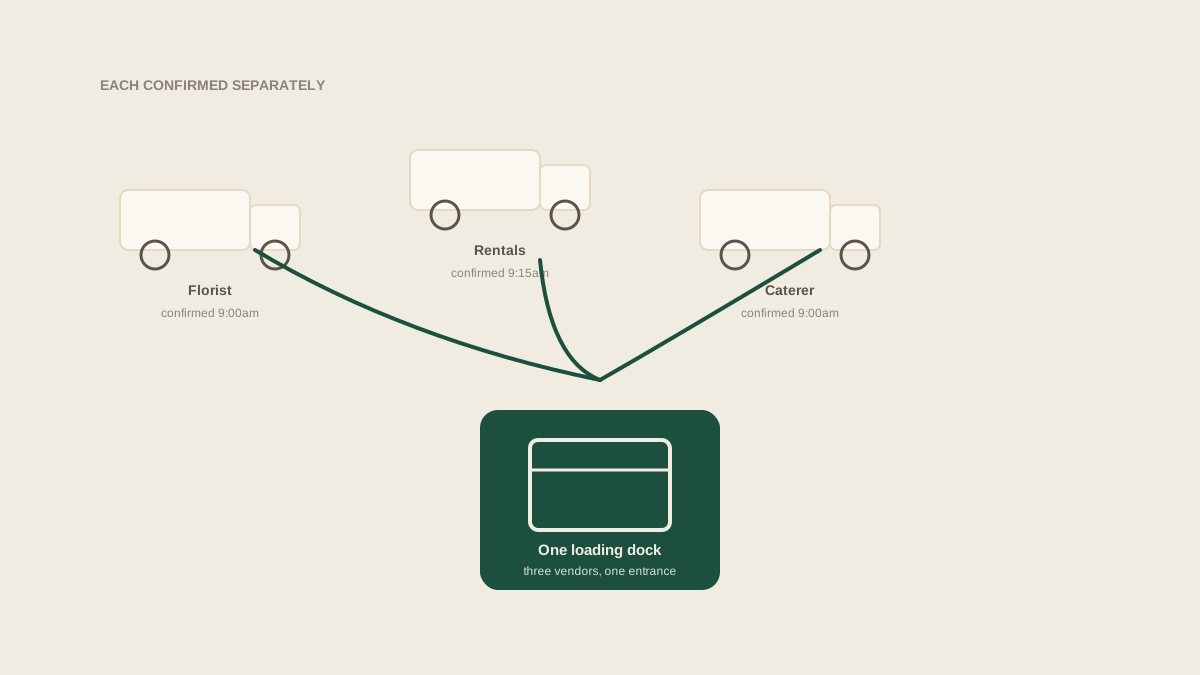
Every vendor involved in a wedding can confirm their own delivery or setup time separately, on schedule, in writing, and the event can still end up with three trucks trying to use the same loading dock within twenty minutes of each other. Nobody did anything wrong individually. The florist confirmed 9am with the studio, the rental company confirmed 9:15 with a different coordinator, and the caterer confirmed 9am directly with the venue. Each confirmation was accurate. None of them accounted for the other two.
Why setup conflicts happen even when every vendor confirms on time
The reason this keeps happening is not carelessness, it is that a delivery time gets confirmed in a conversation between two parties: the vendor and whoever they are coordinating with that day, which might be the studio, might be the venue directly, might be a day-of coordinator brought in separately. Each of those conversations is self-contained. The florist has no reason to ask whether a rental company is also arriving at 9, because from the florist's side, the only relevant fact is what time their own truck needs to be there. The information needed to catch the overlap, every vendor's arrival window in one place, does not exist anywhere until someone deliberately builds it.
The venue detail nobody double-checks
Most venues have exactly one loading dock, one service entrance, or one narrow stretch of driveway that every delivery vehicle has to use, regardless of how many vendors are involved that day. It is rarely mentioned as a constraint in any single vendor's contract, because from each vendor's perspective, it is just where they have always unloaded at that venue. Nobody's contract says a truck may need to wait behind another vendor's, because no individual vendor is responsible for knowing who else is scheduled that morning. The constraint is real and physical, and it sits entirely outside any one vendor relationship.
What actually collides
It is rarely the ceremony or reception times that conflict, those get planned around a fixed schedule everyone can see. It is the setup window before any of that starts: florist delivery, rental drop-off, catering equipment, a band's load-in, sometimes a photo booth or specialty vendor on top of all of that, all needing the same narrow entrance in the same early morning hours before guests arrive. Each vendor picks a time that works for their own crew's schedule that day, with no visibility into what anyone else picked.
A worked example
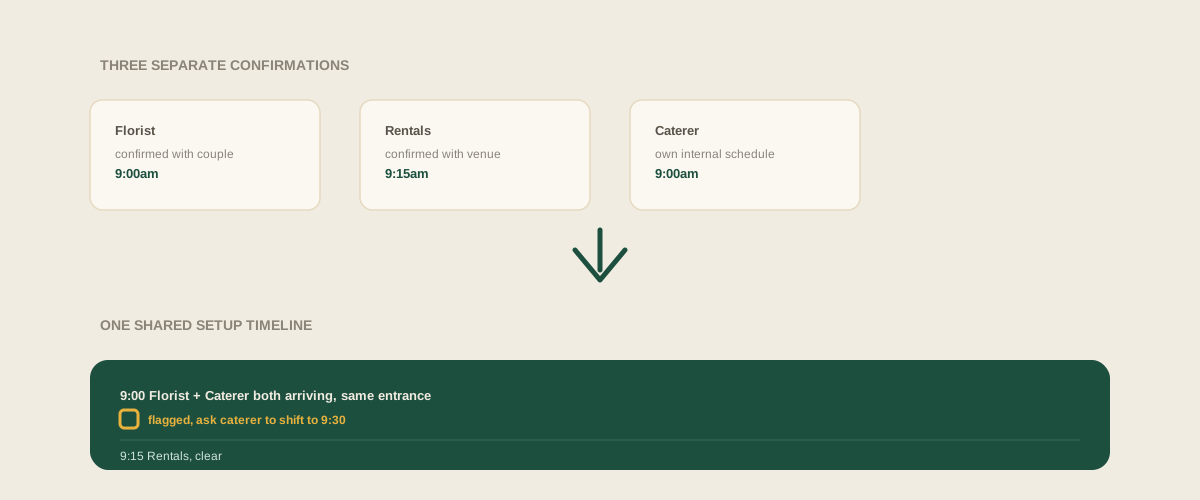
Say a florist confirms a 9am delivery directly with the couple, a rental company confirms 9:15 with the venue's coordinator, and the caterer's setup crew, on their own internal schedule, plans to arrive at 9 as well, without confirming with anyone since their contract just says setup begins by 10am service. On the day, three vehicles converge on one loading dock within fifteen minutes of each other, and the venue has room for one at a time. Nobody missed a deadline. Nobody was told the wrong time. The information that would have caught it, all three arrival windows in one place before the morning of, simply did not exist anywhere until it was already happening in the driveway.
Why a single event timeline does not catch this
Most studios do build a day-of timeline, and it usually includes vendor arrival times. The gap is timing: a timeline is often assembled close to the event, pulling together whatever times each vendor mentioned across separate emails, texts, and phone calls sent over the previous weeks or months. If the florist's 9am and the rental company's 9:15 were each confirmed in a different conversation, weeks apart, building the timeline is the first moment anyone actually looks at both numbers side by side, and by then there may be little room left to ask either vendor to shift. Catching the overlap early enough to actually fix it means having every vendor's arrival time visible together well before the timeline gets assembled, not just once it finally does.
Common mistakes
Assuming the venue will flag a scheduling conflict, when most venues coordinate access for their own staff, not for every outside vendor's arrival relative to each other. Confirming each vendor's time in a separate conversation and only compiling them into one place close to the event, which is exactly when there is the least room to ask anyone to move. Trusting a vendor's general contract language, like setup begins by 10am, as if it were a specific time, when a wide window like that can still land right on top of another vendor's specific confirmed slot. Not accounting for how long a vendor's setup actually takes once inside, so even a staggered arrival time can still overlap if the first vendor is still unloading when the second one shows up.
Where to start
The fix is not asking every vendor to coordinate directly with each other, which adds a layer of communication most vendors have no reason to expect. It is making sure every vendor's confirmed delivery or setup time lands on the same shared board as it is confirmed, whoever confirms it, so overlaps show up the moment a second vendor's time gets added next to the first, not weeks later when someone finally lines up every confirmation to build the day-of timeline.
Frequently asked questions
How much buffer should I build between vendor arrival times at a shared loading dock?
It depends on how long each vendor's setup actually takes and how many vehicles the space can hold at once, but confirming with each vendor how long they expect to need the entrance, not just their arrival time, is what actually makes a buffer accurate rather than a guess.
What if a venue has more than one entrance vendors can use?
That removes some of the risk, but only if it is actually communicated to each vendor which entrance to use rather than left for them to assume the same one everyone else has always used. A second entrance nobody is told about does not prevent the overlap.
Does this only matter for large weddings with many vendors?
It matters most where several vendors need the same physical access point on the same morning, which is more common at larger events but can still happen with as few as two or three vendors if their windows happen to land close together.
Who should be responsible for catching an overlap once it's visible?
Whoever notices two vendors scheduled close together on the shared timeline, day-of coordinator, lead planner, or the venue contact, can flag it and ask one vendor to shift. What matters is that the overlap is visible to someone before the morning of, not who specifically catches it.
Get your studio address, free
Get your studio address
