4 Ways Studios Review Vendor Coordination After a Busy Season (And Where the Lessons Get Lost)
15 October 2026 · 6 min read
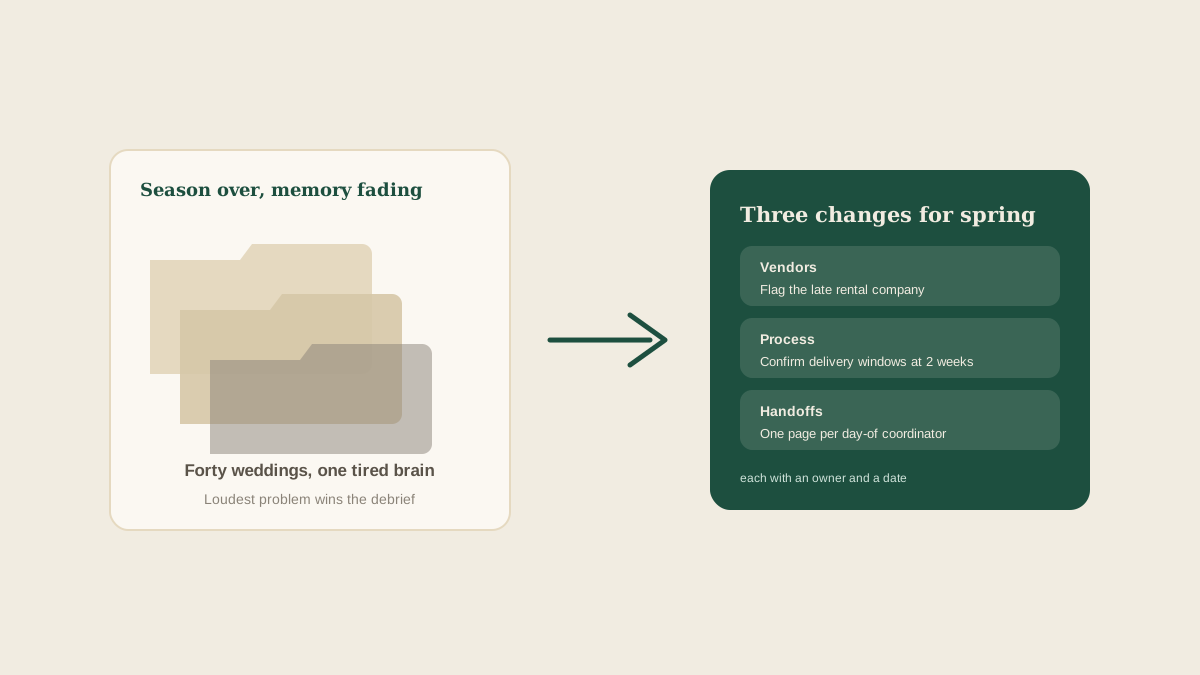
Peak season ends the way a marathon does. You are too tired to think, and the finish line feels like permission to stop. But the weeks right after the last wedding are the only time the lessons are still fresh: which vendors slipped, which handoffs broke, which deadlines nearly got missed. By spring, most of that is gone.
Studios handle this in four common ways. Each captures something useful, and each has a predictable place where the lessons leak out. Here is how they compare, and what to borrow from each.
Method 1: The team debrief meeting
The classic approach is a meeting. Everyone gathers, someone brings snacks, and the team talks through what went well and what did not. It is good for morale, it surfaces issues people had been carrying privately, and it builds shared understanding in a way no document can.
Where it breaks: memory. People recall the loudest problems and the most recent weddings, so a vendor who was quietly late in June is forgotten while a dramatic October mix-up dominates. And unless someone writes decisions down in a form that can be found later, the meeting produces a good feeling and no change. The notes end up in someone's notebook, and the lessons depend on that person remembering to apply them.
Method 2: A shared spreadsheet of what went wrong
Some studios keep a running spreadsheet and ask coordinators to log problems as they happen, then review the sheet at season's end. This beats memory, because the entry is made while the details are fresh, and it makes patterns easy to count.
Where it breaks: effort during the worst weeks. Logging a problem is one more chore when you are already behind, so entries thin out exactly when the problems multiply. The sheet also records the problems but rarely the context, such as which email promised what or what the vendor said when asked, which makes it hard to tell whether a failure was the vendor's, the client's or the studio's own.
Method 3: Individual coordinator notes
In other studios, each coordinator keeps their own notes and gives the lead planner a summary at the end. The people closest to the work usually know the most, and this lets them speak candidly without a room watching.
Where it breaks: fragmentation. Five coordinators produce five formats, and the lead planner has to reconcile them by hand. Two people may have had the same problem with the same vendor and never realize it, because each wrote it up differently. Worse, a coordinator who leaves takes their notes with them. The knowledge was real, but it lived with one person.
Method 4: Reviewing the actual record of the season
The fourth approach is to review what actually happened, using the record the work already produced: when each deposit was due and when it was paid, how long vendor questions waited for an answer, which tasks went overdue and why. Instead of asking people to remember, you look at the trail.
Where it breaks: only when the record is incomplete. If vendor emails, contracts and deadlines were scattered across inboxes, there is no single trail to review. This is where a shared board earns its keep a second time. When vendor emails and contracts were forwarded to Glaard throughout the season, every deadline, request and change was already captured on the right wedding, so the end-of-season review starts from facts rather than recollections.
What to actually look at
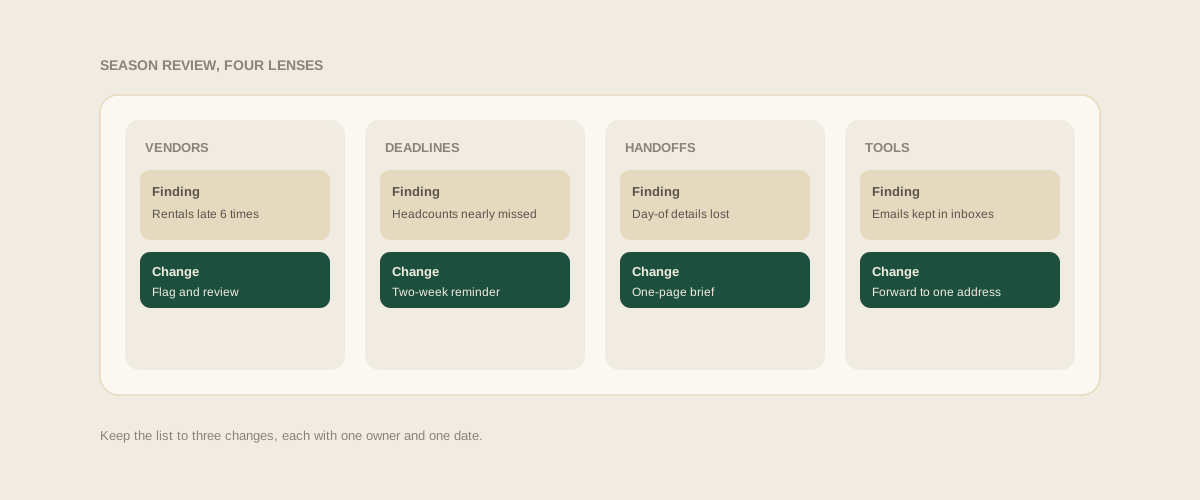
Whichever method you use, a useful review asks a small number of consistent questions. Which vendors had the most overdue or reopened tasks? Where did vendor questions wait longest for an answer, and who was the blocker? Which handoffs, such as planner to day-of coordinator, generated the most last-minute corrections? Which deadlines were nearly missed, and what almost saved them?
It also helps to separate what the studio controls from what it does not. A vendor who is consistently slow to reply is a decision about whether to rebook them. A client who takes three weeks to answer a question is a decision about how you phrase and time those requests. A handoff that loses details is a decision about your own process. Sorting findings into those three buckets makes it obvious which ones you can fix before spring.
Notice that none of these ask who made a mistake. A review that hunts for blame teaches the team to hide problems. A review that hunts for gaps in the process teaches the team to surface them.
Turn findings into three changes
The most common failure of any review is producing a long list and acting on none of it. Limit yourself to three changes for next season, each with a named owner and a date. One about vendors, perhaps retiring or flagging a repeatedly late supplier. One about process, such as adding a two-week confirmation for every delivery window. One about tools or handoffs.
Put those three changes somewhere the whole team will see them in March, ideally as dated tasks on the board rather than lines in a document. A lesson that has no date and no owner is a nice sentence.
Where to start
Within two weeks of your last wedding, pull the list of every task that went overdue this season and sort it by vendor. Whatever name appears most often is your first finding. Add two more from your debrief, assign owners and dates, and the review has already done more than most.
Frequently asked questions
When is the best time to run a post-season review?
Within two to three weeks of your last event. Details are still fresh, but the first wave of exhaustion has passed. Waiting until the new year usually means working from memory.
Who should attend the review?
Everyone who coordinated vendors that season, including part-time and day-of staff. They often saw problems the lead planner never did. Keep the group small enough that each person actually speaks.
How do we review without it turning into blame?
Frame every question around the process instead of the person. Ask where information got stuck, not who dropped it. Looking at the record of what happened helps, since it replaces opinions with a timeline.
How many changes should we commit to after a review?
Three is a good limit. Each should have a single owner and a date. A long list of intentions tends to be forgotten, while three dated tasks get done.
Get your studio address, free
Get your studio address
