How to Catch a Vendor Invoice Discrepancy Before the Final Balance Goes Out
31 August 2026 · 6 min read
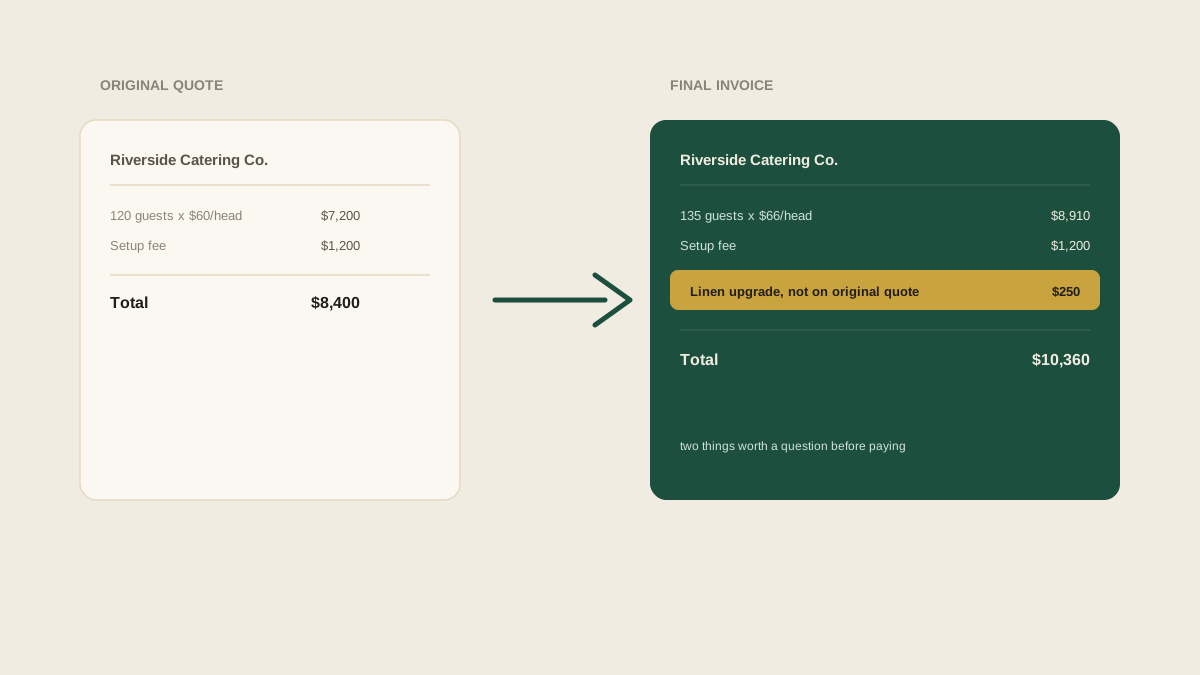
The number on a vendor's original quote and the number on their final invoice are rarely identical, and that is not usually a sign anything went wrong. A headcount grew, an upgrade got added midway through planning, a delivery fee got itemized separately. The problem is not that the number changed. It is that by the time the final invoice arrives, usually weeks or months after the quote was first read, checking whether the difference actually makes sense means remembering exactly what was agreed to back when the quote came in, and that is a much harder thing to do accurately than it sounds.
Why the final invoice rarely matches the quote
A quote is a starting point, not a locked number. Almost every wedding vendor contract mentions things that can change the total before the final invoice is issued: a guest count that gets finalized closer to the date, an add-on the couple decided on partway through planning, a delivery or setup fee that was not broken out in the original estimate, a service charge calculated as a percentage of a total that grew. None of that is unusual, and none of it is inherently a problem. What makes it worth checking is that the final number is supposed to reflect specific, known changes, not just be trusted because it arrived on official-looking letterhead.
The gap is easy to miss for a specific reason
The quote and the final invoice almost never get compared side by side, because they do not arrive at the same time or from the same mental state. The quote gets read early in planning, when there is plenty of time to think it over. The final invoice usually lands close to the event, in the same crowded stretch as a dozen other vendor deadlines, and the instinct is to check that the total looks roughly right and move on to the next thing in the inbox. A minor increase that does not obviously map to anything the studio agreed to can slide through simply because nobody has the original number open in front of them to compare it against.
What actually changes between a quote and a final invoice
Some changes are easy to justify: a headcount that grew by fifteen guests should raise a catering total, and that is expected. Others are worth a second look specifically because they are less visible: a delivery fee added after the fact that was not itemized in the original quote, a service charge calculated on the new, larger total rather than the one everyone actually discussed, a line item for an upgrade the couple mentioned once in passing that never got formally confirmed. None of these are necessarily wrong. They are just the kind of thing that should be checked against what was actually agreed to, rather than assumed correct because the total sounds plausible.
A worked example
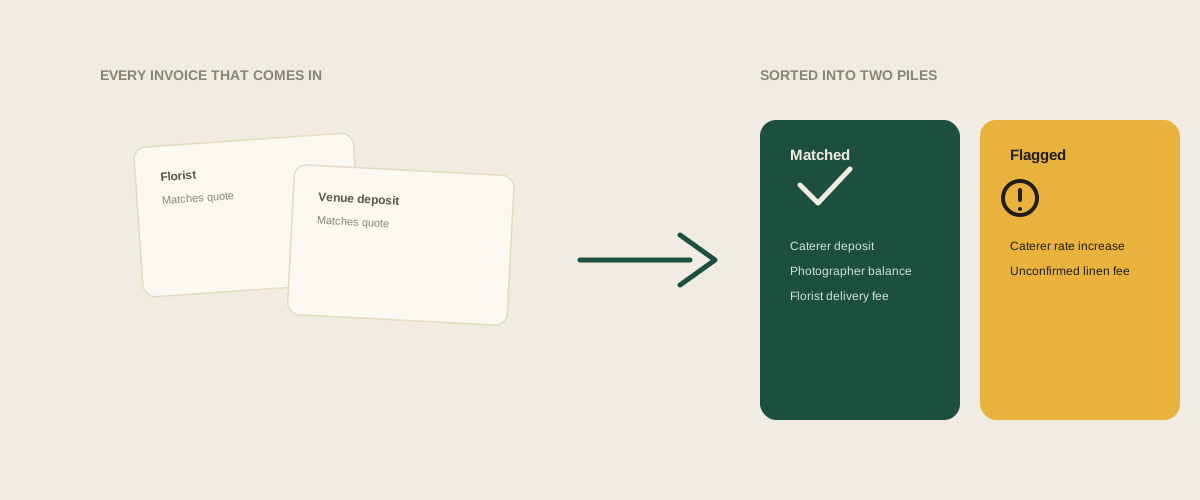
Say a caterer's original quote was $8,400 for 120 guests, itemized by per-person cost plus a flat setup fee. The final invoice arrives at $9,800, reasonable at a glance, since the headcount grew to 135. Laid next to the original quote, though, the per-person rate on the final invoice is actually a few dollars higher than what was quoted, and a new line item for a linen upgrade appears that nobody remembers confirming. Neither of those two things is necessarily wrong, the rate could reflect a seasonal adjustment mentioned in the original contract's fine print, and the linen upgrade might have been agreed to verbally at a tasting. But neither is obviously right either, and the only way to know is to have the original quote next to the final invoice long enough to actually compare the two, rather than checking that the new total sounds roughly plausible and moving on.
Why checking from memory does not work
The instinct is to eyeball the final total and ask whether it feels right given what has changed since the quote. That works for large, obvious differences. It does not work for a rate that crept up by a few dollars per person, or a fee that got itemized separately for the first time, because there is no way to notice a small discrepancy without the actual original number to check it against. A rough memory of the per-head cost is not precise enough to catch a small difference, and by the time the final invoice arrives, the original quote is often buried in an inbox from months earlier, not open on screen next to the new number.
Common mistakes
Approving a final invoice quickly because it is due soon and re-reading the original quote feels like it would slow things down, when the comparison usually takes a few minutes if both documents are easy to find. Assuming a vendor would flag their own billing error, when most invoice mistakes are simple oversights that nobody on the vendor's side is specifically checking for either. Only comparing the bottom-line total instead of the line items underneath it, which is exactly where a rate change or an unconfirmed add-on hides even when the final number looks reasonable on its own.
Where to start
The fix is not distrusting every vendor invoice that comes in, most are accurate. It is keeping the original quote easy to find and next to the final invoice the moment it arrives, so a comparison takes minutes instead of requiring anyone to remember exact numbers from months earlier. Forwarding both the original quote and the final invoice to the same place as they arrive means the comparison is a matter of looking at two documents side by side, not trusting a total because it sounds close enough to what everyone remembers agreeing to.
Frequently asked questions
How long after the original quote does a final invoice usually arrive?
It varies by vendor, but weeks to a few months before the event is common for many wedding vendors, often close enough to the date that other final-details deadlines are competing for the same attention, which is exactly why the comparison is easy to skip.
What should I do if I find a discrepancy?
Ask the vendor directly rather than assuming it was intentional or a mistake. Most differences have a straightforward explanation, a rate change in the contract fine print, a verbal add-on, and the vendor can usually point to it quickly once asked.
Is this only worth doing for large vendor contracts?
It matters most wherever the total is large enough that a small percentage difference is still real money, which for most weddings includes catering, venue, and any vendor billing per guest. A flat-fee vendor with no variables is less likely to need this kind of check.
Does keeping the original quote actually require a separate system?
No. It just requires the original quote to be easy to find again later, forwarded to the same shared place as everything else about that vendor, rather than left in whoever's inbox first received it months before the final invoice shows up.
Get your studio address, free
Get your studio address
