4 Ways Studios Keep Vendor Email From Following the Planner Home Every Night (And Where Each One Leaks)
12 October 2026 · 6 min read
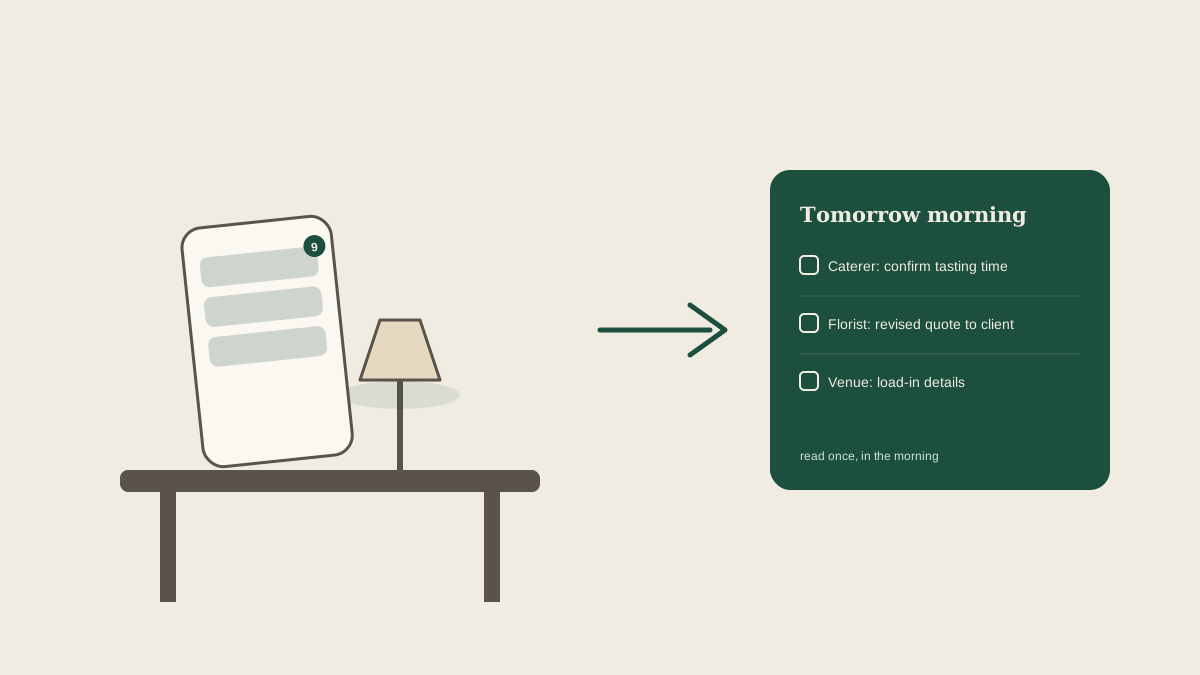
Wedding vendors do not keep office hours. The caterer answers questions at 9 PM because that is when the kitchen slows down. The florist sends a revised quote at 6 AM because that is when the flower market opens. The photographer replies from a car on Sunday afternoon. For the person whose phone receives all of it, the working day never really ends.
Most planners know this is not sustainable, and most have tried to fix it. Here are four common approaches, and where each one still lets the work follow you home.
1. Check email constantly so nothing is missed
This is the default, and it comes from a reasonable fear. If a vendor needs an answer by tomorrow morning and you do not see their message tonight, something might break. So the phone stays within reach, the notifications stay on, and the evening becomes a series of small interruptions.
The cost is hidden. Each check takes thirty seconds, but it pulls attention back to work every time. And because you read everything as it arrives, you also carry everything: a deposit reminder, a headcount question and a delivery confirmation all land in the same stretch of your evening, and you hold them in your head until morning. The inbox is not closed, and neither is your mind.
2. Set office hours and tell vendors you will reply tomorrow
The second approach is to draw a line. You tell vendors that you reply between 9 and 5, you add it to your signature, and you stop checking after hours.
This works for routine messages, and it is healthy. Where it leaks is the exception. Some messages genuinely cannot wait: the venue changes load-in time, a vendor is stuck in traffic, a rental truck breaks down. Because you are no longer reading the inbox in the evening, the urgent message sits unseen until the next morning, and the one time it matters you pay for the boundary. Planners who try this often drift back to option one after the first missed emergency.
3. Hand evening email to a rotating on-call coordinator
Larger studios sometimes share the burden. One coordinator is on call each evening or weekend and watches the shared inbox, and the others log off.
This is fairer, and it spreads the load, but it has two weak points. The first is context. The person on call does not know what every vendor agreed to for every wedding, so they can acknowledge a message but cannot always judge whether it is urgent. The second is handoff. Whatever the on-call coordinator reads in the evening has to be passed to the right planner in the morning, usually by a message or a note, and some of it gets lost in the translation. The inbox is covered, but the knowledge is still scattered.
4. Forward everything to a shared board and triage by task, not by inbox
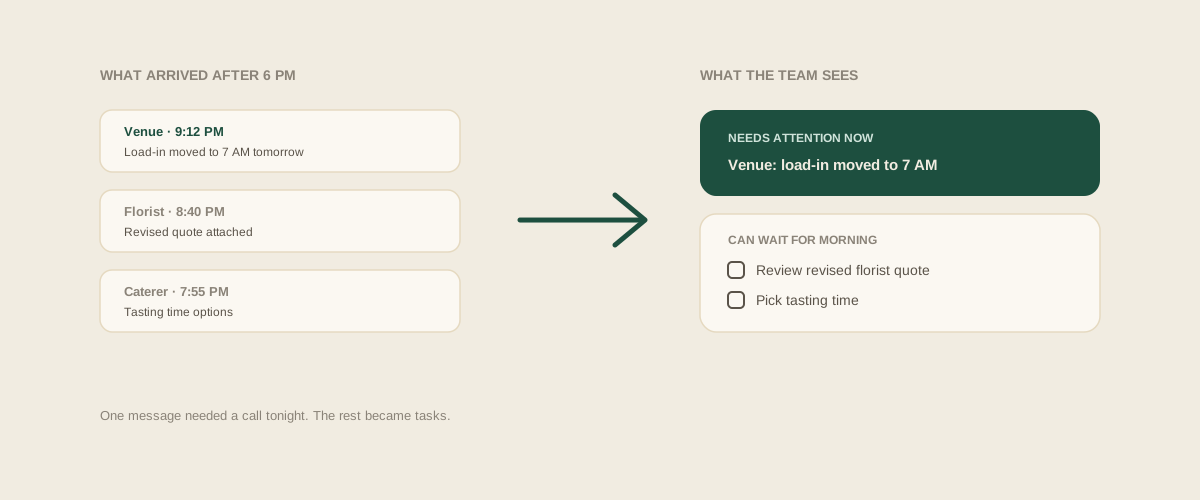
The fourth approach changes where the work lives. Instead of reading vendor emails in the inbox, the studio forwards them to a shared address. Glaard reads each one, attaches it to the right wedding and vendor, and turns the request or deadline inside it into a task on the shared board, with the original message linked.
The effect on the evening is significant. A vendor writes at 9:40 PM and the message becomes a task, tagged with the wedding, the vendor and the due date. Nobody has to read it tonight to know it exists. The next morning, the first thing anyone sees is the board, sorted by what is due and when, and the messages that were truly urgent are clearly separated from the ones that are not.
It also fixes the on-call problem. A coordinator who is covering the evening sees tasks with context attached, not a raw inbox, so they can tell at a glance whether the florist's note about Saturday is a today problem or a Thursday problem.
What still needs a human
No tool can decide for you which messages are emergencies. What it can do is make the decision cheaper. A short list of true emergencies, such as anything that mentions the event date within 48 hours, a vendor running late, or a venue change, can be flagged on the board so that the one message that matters stands out among the ones that do not.
Write that list down and share it with your team and your vendors. "Call me if it is any of these, otherwise I will see it in the morning" is a promise that vendors tend to respect, because it tells them exactly when to pick up the phone.
A morning routine that closes the loop
Whichever approach you choose, give the first fifteen minutes of the day to the board. Open it, sort by due date, and go through what arrived overnight. Reply to what needs a reply, assign what needs an owner, and snooze what can wait. Doing this once, deliberately, replaces dozens of half-attentive checks across the evening, and it means vendors still get timely answers, just at a time that suits you.
Over a few weeks, most studios find that response times barely change while the number of late-night interruptions drops sharply. The work did not shrink. It simply moved to a place and time where it can be done properly.
Where to start
For one week, notice which evening emails actually needed a same-night response. Most planners find the number is far smaller than they feared, often one or two out of dozens. Use that to write your emergency list, forward everything else to the board, and give yourself the evening back.
Frequently asked questions
Will vendors be annoyed if I do not reply in the evening?
Rarely, as long as you set the expectation. A line in your signature and a clear emergency channel, such as a phone number for true urgencies, is usually enough. Vendors mostly want to know how to reach you when it matters.
What counts as a real emergency for a vendor message?
Anything that affects the event within the next 48 hours, such as a vendor running late, a venue access change, a delivery problem or a cancellation. Write your own list and share it, so the team and the vendors agree on the same definition.
How does a shared board help when I am not reading the inbox?
Each forwarded vendor email becomes a task on the right wedding and vendor, with a due date and the original message attached. You can see what arrived and what it needs without reading every message, and urgent items stand out.
Is an on-call rotation worth it for a small studio?
It can be, but only if the on-call person can see the context for every wedding. Without a shared board, an on-call coordinator can only acknowledge messages, and the planner still has to re-read everything the next morning.
Get your studio address, free
Get your studio address
