How to Track What the Couple Decided at a Tasting or Trial Before the Vendor Forgets It
22 October 2026 · 6 min read
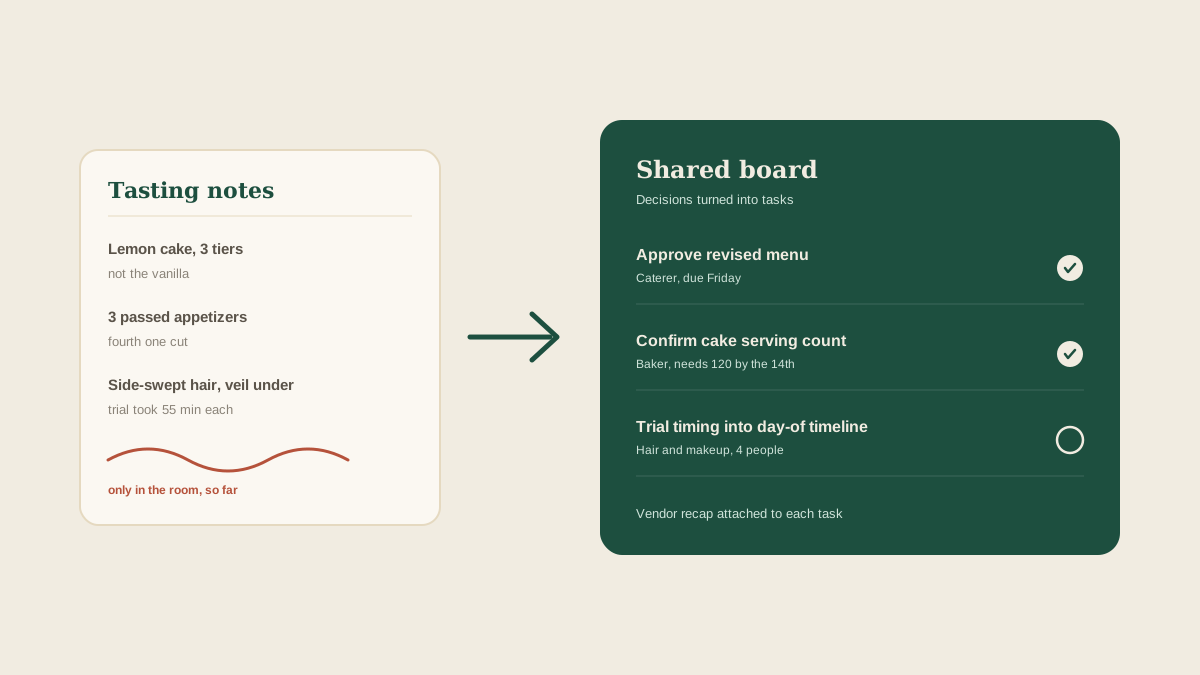
A tasting is one of the few planning meetings where the couple makes a pile of small, specific decisions in a single hour. The lemon cake, not the vanilla. Three passed appetizers, not four. The side-swept style with the veil pinned underneath. Everyone nods, the vendor writes something down, and the couple leaves happy.
Then the details start to leak. The vendor's notes are on a sticky pad or in their own system. The couple remembers it slightly differently by the next week. The planner, who may not have been in the room, learns what was decided from a half-sentence in a text. Six weeks later the menu card arrives with the fourth appetizer on it.
The tasting itself is rarely the problem. The gap is between the decisions made in the room and the tasks that need to exist because of them. Here is how to close it.
Treat the tasting as a source of tasks, not just a memory
Most studios schedule a tasting and consider the job done once the date is in the calendar. But a tasting always produces follow-up work: a revised proposal from the caterer, a confirmed final guest count for the cake, a deposit that now has a number attached, a written list of the hair and makeup timing for each person.
Before the appointment, decide where those follow-ups will land. If the answer is "in my head" or "in the vendor's notes", you have already planned the gap.
Get the vendor's written recap within a day
The vendor is the one person who was definitely paying attention to the food, the style or the sample, so ask them to send a recap by email the next day. It should state what the couple chose, what they ruled out, what changes the price, and what the vendor needs next.
Some vendors do this automatically. Many do not, and a polite request after the first one or two weddings usually gets it into their routine. A recap in writing is far more useful than a verbal "we've got it", because it can be compared with what the couple remembers.
Capture what the couple says, too
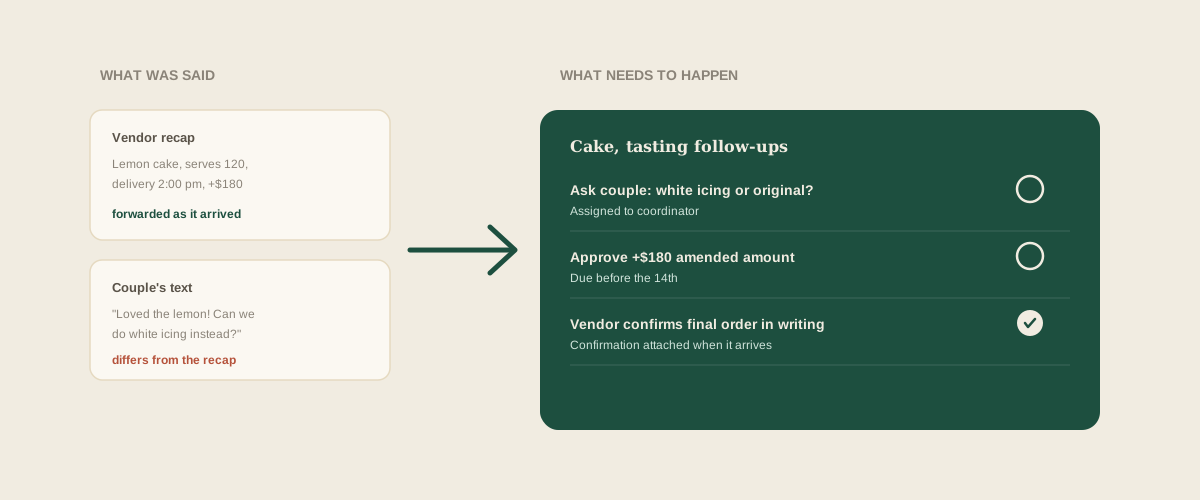
The couple will often send their own follow-up in the car on the way home: a text with a photo of the sample they loved, or a note that they changed their mind about the pink icing. That message is a decision as much as the vendor's recap is, and the two do not always match.
Forward both to the studio as they arrive. Glaard reads the vendor's recap and the couple's text, including a screenshot of a message thread, and pulls out the actionable pieces: the revised menu to approve, the guest count the baker needs by a given date, the trial timing that still has to be confirmed. They land on the wedding's shared board as separate tasks with the original message attached, so the team is working from the words people actually used.
Spot the conflicts early
Once both versions sit side by side, mismatches become visible while they are still cheap to fix. If the caterer's recap lists four passed appetizers and the couple's text mentions three, that is a question to settle this week, not at the final headcount.
A simple habit helps. For each decision, look for a vendor statement and a couple statement. If only one exists, ask for the other. If they disagree, put the difference on the board as a task assigned to whoever will message the couple.
Attach prices and dates to each decision
A decision made at a tasting often changes money or a deadline without anyone saying so. Upgrading the dessert table adds a cost. Adding two bridesmaids to the trial adds a time slot and a fee. A revised menu usually resets the date by which the caterer needs final numbers.
Ask the vendor to name those effects in the recap, and make sure each one turns into its own line: an amended amount to approve, a new due date, a revised payment. If you leave them folded into the general notes, they surface as surprises on the final invoice.
Close the loop with a confirmation, not a memory
The last step is the one most often skipped. Once the vendor has the final decision, they should confirm it back in writing: "We have the lemon cake, three tiers, serves 120, delivery at 2:00 pm." Forward that confirmation to the studio address so the matching task is marked done with the evidence attached.
That confirmation is what you point to on the wedding day if anyone asks. It is also what your coordinator can read if they are covering the event and were never in the room.
For hair and makeup trials, track the timing, not just the look
Trials have an extra trap: the look gets approved, but the schedule does not. How long each person's hair and makeup took in the trial is the best predictor of the real morning, and it is the first thing to go missing.
Ask the artist to send the duration for each person and the total team size needed. Put it on the board as a task feeding the day-of timeline, so the start time is based on the trial, not a guess.
Where to start
Take the next tasting or trial on your calendar. Before it happens, list the follow-ups you expect and decide who owns each one. After it, check that you have a recap from the vendor, a note from the couple, and a confirmation from the vendor. Any gap in those three is a decision that could still change without anyone noticing.
Frequently asked questions
Who should take notes at a tasting?
The vendor will take their own, but the studio should not rely on them. Have a planner or coordinator note the decisions, or ask the vendor to send a written recap the next day so there is something to compare with the couple's version.
What should a vendor's tasting recap include?
What the couple chose, what they ruled out, anything that changes the price, and what the vendor needs next, with dates. If the recap leaves out cost or deadline changes, ask for them in a reply.
What if the couple's text and the vendor's recap disagree?
Treat the difference as a task. Put both versions side by side, assign someone to ask the couple, and get the answer confirmed by the vendor in writing before anything is ordered or printed.
How does Glaard help after a tasting or trial?
Forward the vendor's recap and the couple's follow-up messages to your studio address. Glaard reads them and turns the decisions, revised amounts and confirmations still owed into tasks on the wedding's shared board, with the original messages attached.
Get your studio address, free
Get your studio address
