How to Track the Cancellation and Refund Deadlines Buried in Vendor Contracts
12 October 2026 · 6 min read
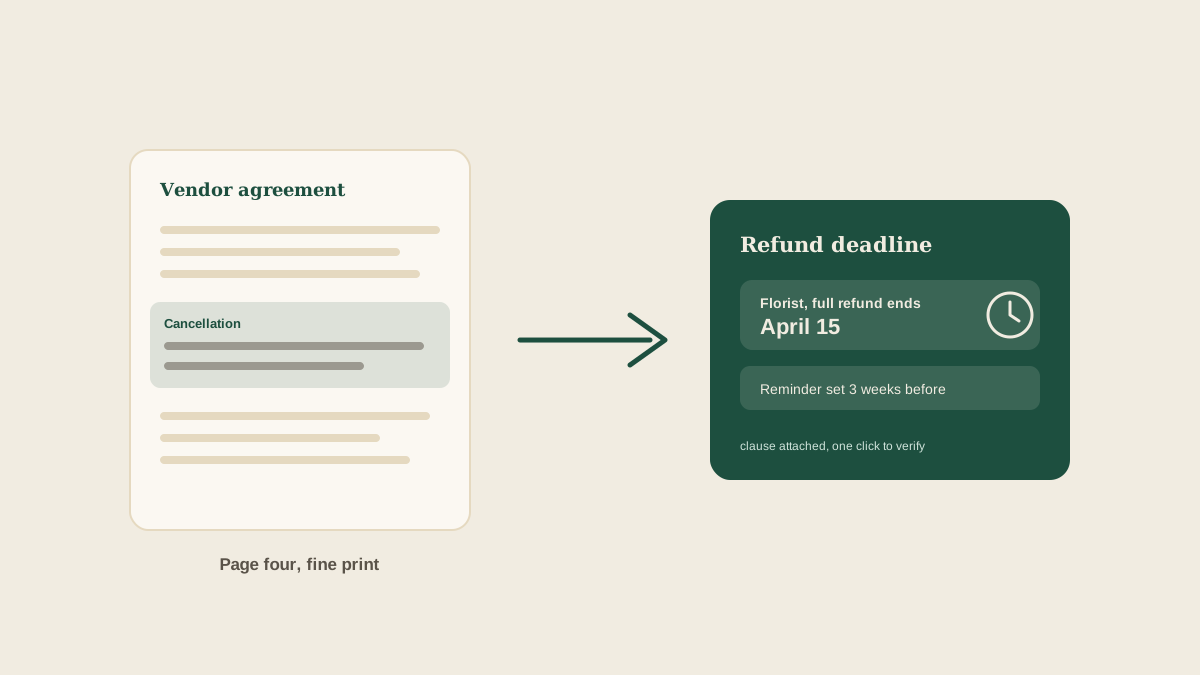
Ask a planner when the florist's final payment is due and they will usually know. Ask when the couple can still cancel the florist and get half the deposit back, and the room goes quiet. That date lives in a paragraph on page four, between the substitution policy and the clause about delivery access, and it matters exactly once: on the day the client changes their mind.
Cancellation and refund windows are the least visible deadlines in vendor coordination. They are not payments, so they do not trigger an invoice. They are not event milestones, so they do not appear on the timeline. They are simply dates after which a decision costs real money, and they pass silently. Here is how to make them visible.
Why these dates get missed
Payment deadlines are active. Someone sends a reminder, a card gets charged, a balance shows up in the client's inbox. Cancellation windows are passive. Nothing happens when they arrive or when they pass. The contract simply starts saying something different about what the couple is owed.
They are also written in wildly different ways. One caterer allows a full refund up to 90 days out. A photographer keeps the retainer from the moment of signing but refunds the balance up to 30 days before. A venue has a sliding scale, with 50 percent back until six months out and nothing after. A rental company counts days from the order, not from the event. No two contracts use the same unit, and the date you care about is usually a calculation, not a printed number.
Pull the dates out at signing, not at the problem
The best moment to find a cancellation window is the day the contract arrives, while the vendor's terms are the only thing you are reading. Read it once for the following, and write each answer down in plain language.
What can the client cancel, and until when? What do they get back at each stage? Is the deposit ever refundable, or only the balance? Can the date be moved instead of cancelled, and is there a fee? What happens if the vendor cancels? Convert every relative deadline into a calendar date using the event date. "60 days before" on a June 14 wedding is April 15, and April 15 is the date that belongs on your board, not the phrase.
Put each window on the vendor's task, with the clause attached
A date in a notes field is almost as bad as a date in the contract. The deadline should live as a task on the vendor, with a title that says what it protects, such as "Last day for full deposit refund, florist, April 15", and the original clause attached so anyone can verify it in ten seconds.
Glaard does the first pass of this for you. When the contract or the vendor's confirmation email is forwarded to your studio address, the cancellation and refund language is surfaced as a dated task on the right wedding and the right vendor, with the source message linked. A coordinator still checks the calculation, but nobody is starting from a blank page.
Make the windows visible as a timeline, not a list
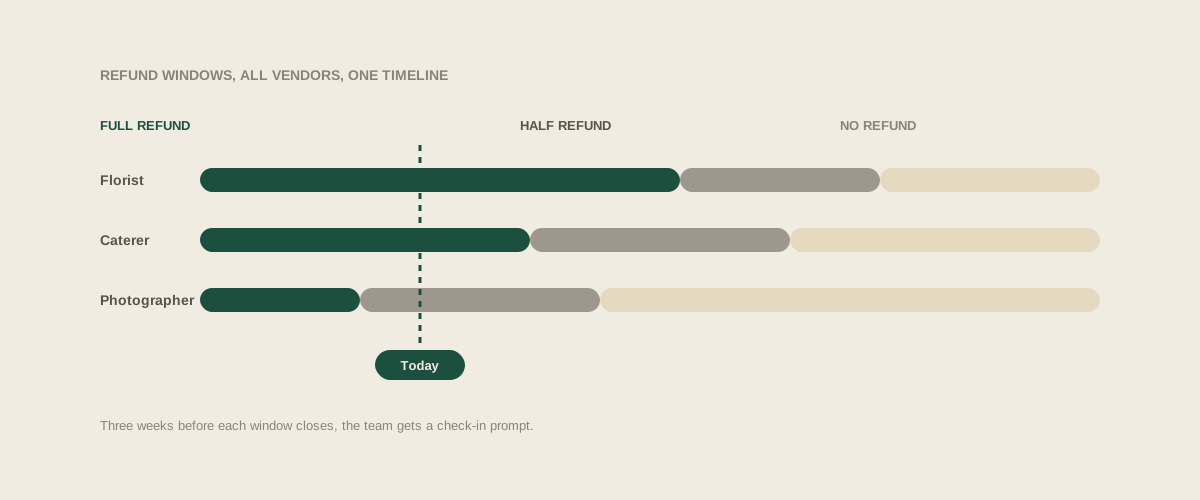
Once the dates are on the board, the useful view is not alphabetical. It is chronological across every vendor on the wedding, with the zones labelled. Full refund until April 15. Half refund until May 15. Nothing after that. A single glance tells you the couple is currently inside the full-refund window for three vendors and about to leave it for the photographer.
This is also the view that makes the conversation with the client easy. "Before we lock in the florist, here is when you can still change your mind" is a helpful, professional sentence. Learning the window has closed after the client says they want something different is the opposite.
Set reminders ahead of the window, not on it
A reminder on the last day of the full refund is nearly useless. Nobody can make a decision on the day, because the client needs time to think and the vendor needs time to respond. Set the reminder two or three weeks before each window closes, and word it as a prompt for a check-in: "Full refund on the florist ends April 15. Anything the couple is unsure about?"
Most of the time the answer is no, and the check-in takes thirty seconds. The one time the answer is yes, it saves the client several hundred dollars and saves your studio a very uncomfortable email.
Watch for changes that reset the clock
A date change, a venue change or a major scope change often resets the cancellation terms, sometimes in the vendor's favor. Moving a wedding from June to September can turn a 60-day refund window into a 60-day window counted from the new date, or it can trigger a rebooking fee and void the old terms entirely. Whenever the wedding changes materially, re-read the cancellation clause for each affected vendor and update the dates.
This is the step that is easiest to forget, because the stressful part of a date change is finding available vendors, not checking old refund terms. Add a single task to the date-change checklist: "Re-check cancellation windows for every vendor."
Where to start
Take your next upcoming wedding and open the three largest vendor contracts. Find the cancellation clause in each, convert it into a calendar date, and put those three dates on your board with the clause attached. It takes about twenty minutes, and it turns the quietest deadlines in the contract into ones the whole team can see.
Frequently asked questions
Which vendor contracts usually have the strictest cancellation terms?
Venues, caterers and photographers tend to have the earliest and steepest cutoffs, because their calendars and costs are committed far in advance. Rentals and florists are often more flexible but count their days differently, so read each one individually.
What is the difference between a deposit and a retainer?
A retainer is typically non-refundable and reserves the vendor's time, while a deposit is part of the price and may be refundable up to a certain date. Contracts do not always use the words consistently, so check what the clause actually says about refunds.
How early should I remind a client about a refund window closing?
Two to three weeks before the window closes is a good rule. It gives the client time to decide and gives the vendor time to respond, which a same-day reminder cannot do.
Do cancellation terms change if the wedding date moves?
Often, yes. A date change can reset the refund window, trigger a rebooking fee or void the original terms. Re-read the cancellation clause for every affected vendor whenever the date, venue or scope changes.
Get your studio address, free
Get your studio address
