4 Ways Studios Keep Vendor Coordination From Breaking During Peak Season (And Where Each One Still Cracks)
10 September 2026 · 7 min read
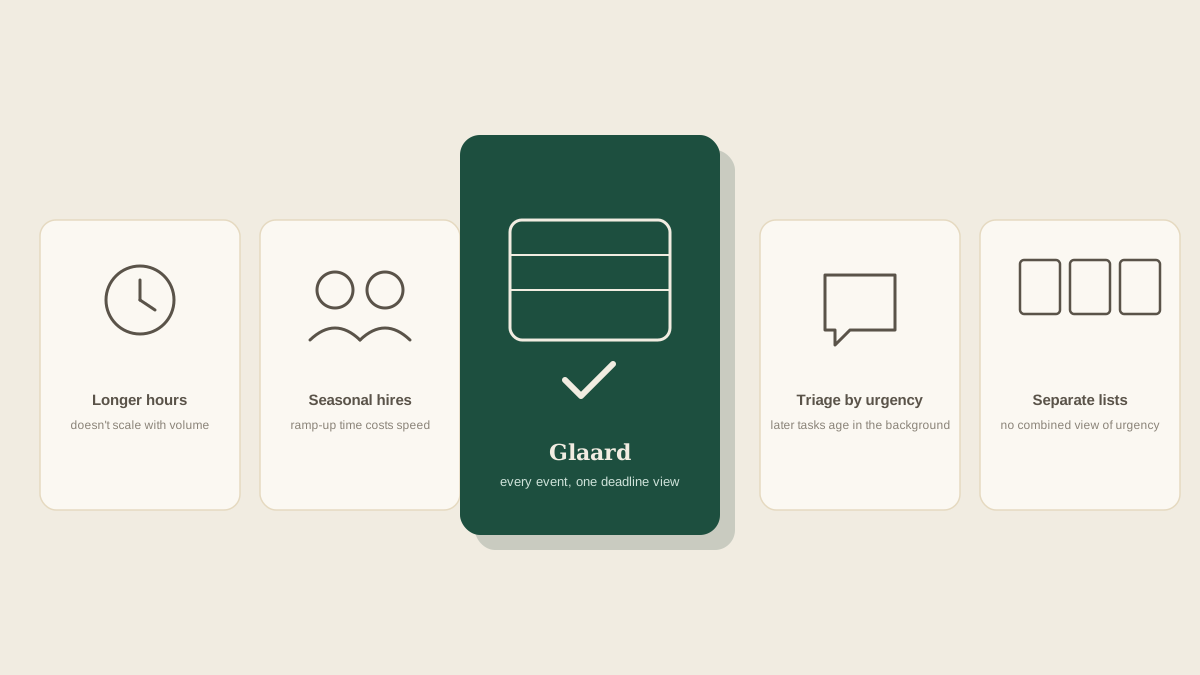
Vendor coordination for one wedding at a time is forgiving. A missed callback gets caught the next day, a deadline that slips by a few hours barely registers, and a planner can usually hold the whole picture in their head without much effort. Peak season removes that slack. When a studio has five events booked across six weekends and each one has its own florist, caterer, and rental company on their own timeline, the margin for a task slipping unnoticed shrinks fast. Here's what four common approaches to peak season actually cover, and where each one still cracks.
Working later and starting earlier
The most common response to a busier season is simply putting in more hours, answering vendor emails before the rest of the team is awake or catching up on tasks after everyone else has logged off. This genuinely creates more capacity in the short term, and for a studio that's only moderately busier than usual, it can be enough on its own. It doesn't scale with the season, though. The hours a planner can add are finite, and a studio running five concurrent events on extended hours is still running five concurrent events, just with a more tired person managing them.
Hiring temporary or seasonal coordinators
Bringing on extra hands for the busy months adds real capacity that working longer hours can't, another set of eyes on vendor deadlines and another person who can take a call while someone else is on-site. The tradeoff is ramp-up time. A seasonal coordinator doesn't arrive with the same context a full-time team member has built up over prior events, which vendors are reliable, which clients need extra hand-holding, and getting them productive fast usually depends on how well that context can be handed over quickly rather than learned the slow way over a few events.
Triaging: giving full attention to whichever event is closest
Some studios cope by consciously prioritizing whichever wedding is nearest on the calendar, reasoning that a task due in three weeks can wait if there's a fire to put out for an event happening this Saturday. This is a reasonable response to genuine scarcity, urgent work should come first. The risk is that "can wait" tasks for events further out don't actually pause, their deadlines keep approaching in the background, and a triage system that's always fighting the closest fire has no natural mechanism for catching a task quietly aging past due while everyone's attention was on next weekend's event.
Running each event on its own separate list
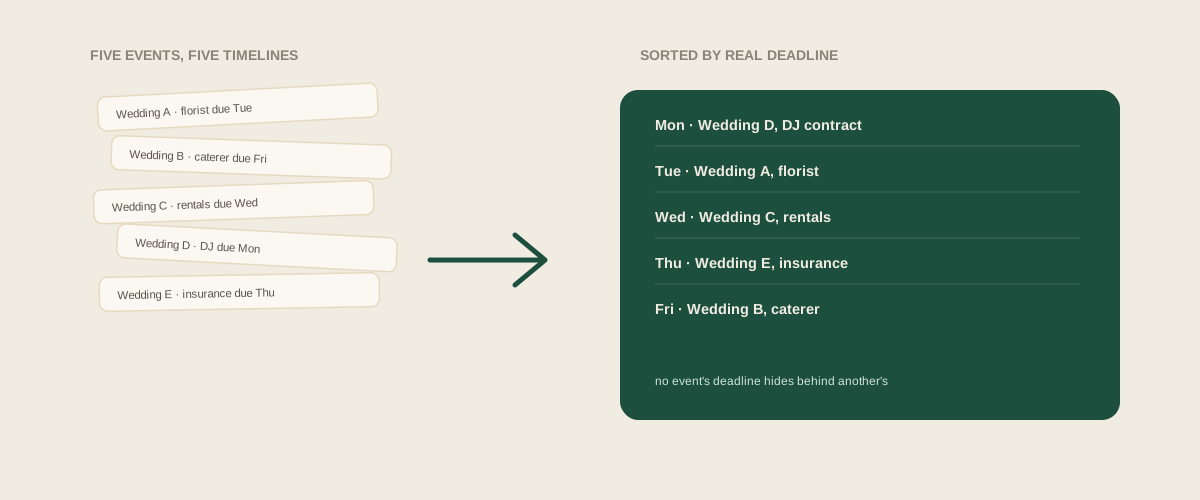
To keep events from blurring together, some studios keep a fully separate tracker, a notebook, a spreadsheet tab, a dedicated email folder, for each wedding, on the logic that isolation prevents cross-contamination between events. This does stop one event's vendor details from getting mixed up with another's. It creates a different problem instead: nothing shows the team which task across all five events is actually the most urgent right now. A studio has to open five separate lists and mentally merge them to see the real picture, which is exactly the kind of cross-referencing that's easy to skip when everyone is already stretched thin.
Why all four approaches share the same gap
Every one of these methods adds capacity or imposes some order, more hours, more people, a priority order, cleaner separation, but none of them actually produces a single, current view of every vendor deadline across every event a studio is running at once, sorted by when it's actually due rather than by which event happens to feel most urgent today. That gap is where a task quietly goes overdue: not because nobody could have handled it, but because nothing surfaced it as the most pressing thing to do next.
What actually holds up through peak season
The fix isn't picking one of these four and doing it harder. Working extra hours, adding seasonal help, and triaging urgent fires are all still useful, peak season really does need more effort and more hands. What changes the outcome is whether all of that effort is pointed at a single shared view where every vendor task across every event sits by its real deadline, so a task for an event three weeks out doesn't quietly go stale just because this Saturday's wedding is eating all the attention today.
How to choose
A studio running two or three events a month can often get through a busier stretch on extended hours and good triage instincts alone. Past four or five concurrent events, the studios that come through peak season without a dropped vendor task are usually the ones that consolidated everything onto one board sorted by actual deadline, rather than the ones with the most disciplined habit of checking five separate lists by hand.
Frequently asked questions
How many concurrent events does a studio need before this becomes a real problem?
There's no exact number, it depends on team size and how much each event's vendor list overlaps with the others. As a rough signal, if a studio ever catches itself asking "wait, did we already confirm that with the caterer, or was that a different event", that's usually a sign the current system has stopped scaling.
Is hiring seasonal coordinators worth it if the ramp-up time is a real cost?
Often yes, since even a coordinator who's still ramping up adds capacity a solo team doesn't have. The ramp-up cost is smaller when there's an existing shared record of vendor context, reliability notes, prior conversations, for them to read into, rather than requiring the context to be explained verbally by whoever is already the most stretched.
Should each event still have its own separate section, even on a shared board?
Yes, tagging every task to its event keeps details from blurring together the way a single undifferentiated list would. The goal isn't to remove that separation, it's to also have a combined view sorted by deadline so the team can see what's most urgent across every event at once, not just within one.
What's the actual cost of a dropped vendor task during peak season, compared to a slower season?
The task itself doesn't get more expensive to fix, but the recovery window shrinks. During a slower season there's usually slack to catch and correct a missed deadline before it affects the event. During peak season, with several events converging on the calendar at once, that slack often isn't there, which is why the same size mistake tends to do more damage.
Get your studio address, free
Get your studio address