How to Keep Vendor Coordination Moving When the Lead Planner Is Unreachable
19 October 2026 · 6 min read
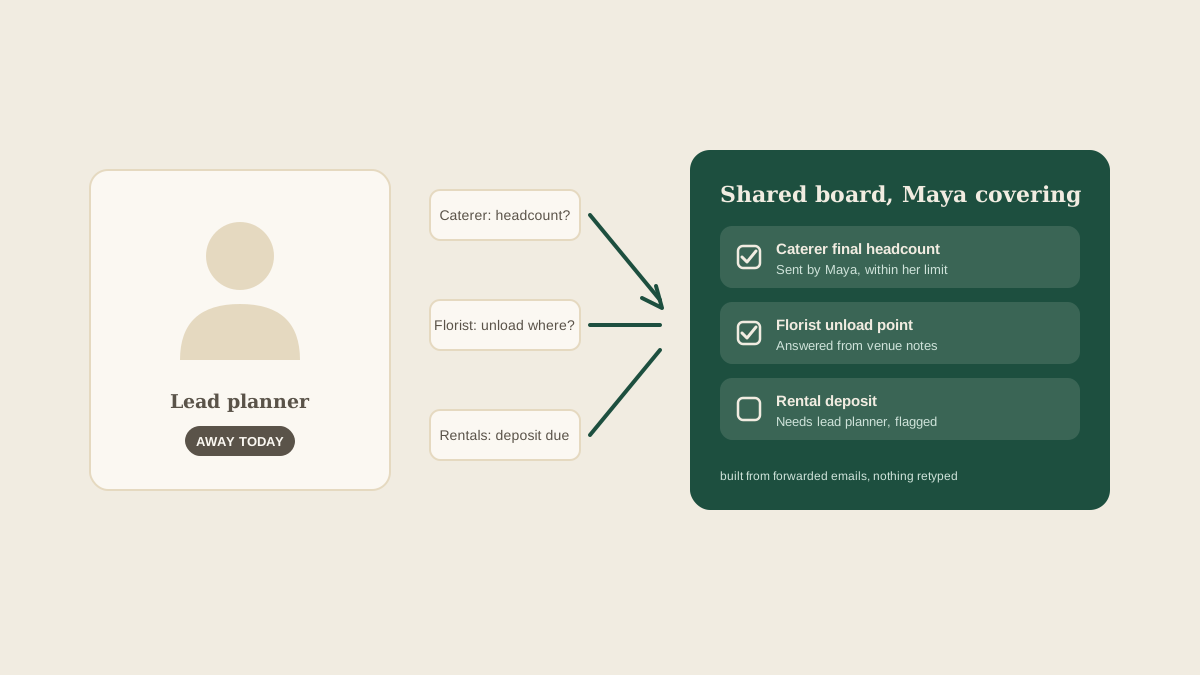
Sooner or later the lead planner is unreachable at exactly the wrong moment. They are mid-ceremony on a Saturday, on a long-haul flight to a site visit, or home with a fever. Meanwhile the caterer wants a final headcount by noon, the florist is asking where to unload, and the rental company says the deposit window closes today.
In most studios, what happens next is a scramble. A coordinator texts the planner who cannot answer, scrolls through old threads trying to piece together what was agreed, and eventually guesses. Sometimes the guess is fine. Sometimes it costs a deposit or a day of goodwill with a vendor.
The fix is not a heroic coordinator. It is a studio where the information and the authority to act are already shared before anyone disappears.
Find out what only the lead planner knows
Start with an honest audit. Over the next two weeks, note every time someone on the team says "I need to ask her" or "he would know." Those moments are your map of single points of failure.
They usually fall into three groups: facts (what the venue agreed to, which vendor needs a gate code), deadlines (when each deposit and final count is due), and decisions (how much a coordinator can approve without checking). The first two can live on a shared board. The third needs a written rule.
Write down what a coordinator can decide alone
Most delays happen not because the answer is unknown but because nobody is sure who is allowed to give it. Settle that ahead of time, in plain numbers.
For example: any coordinator can approve up to an agreed amount of overtime, confirm or move a delivery window by up to an hour, and answer routine vendor questions that the contract already covers. Anything touching the contract total, a vendor swap or a client promise goes to the lead planner, or to a named backup if they cannot be reached within a set time, say two hours on a weekday.
Put that one page where the whole team can find it. It turns a stressful judgment call into a lookup.
Make the vendor record readable without the planner
A coordinator covering for the lead should not have to reconstruct a wedding from a forwarded chain of forty emails. Every wedding needs a current picture: who is booked, what is owed and when, what has been confirmed, and what is still waiting on someone.
This is where forwarding does the heavy lifting. When vendor emails, contracts, delivery-window texts and screenshots of client messages go to your studio address as they arrive, Glaard reads them and puts the deposit dates, final counts and confirmations onto the shared board for that wedding. The lead planner does not have to remember to update anything, so when they vanish for a day, the board is still current.
Name a backup for each wedding
Studio-wide coverage is vague. Per-wedding coverage is not. For every event, name one person as the backup lead, and make sure they have actually been in the loop, not just listed.
A simple test: could the backup tell a vendor today what is confirmed and what is outstanding for this wedding, without asking anyone? If not, they are a name on a document, not a backup. A ten-minute walkthrough of the board a few weeks out is usually enough to change that.
Plan the planned absences
Most unreachable days are known in advance: a vacation, a wedding weekend with no phone allowed, a flight. For these, do a short handover the day before. List the deadlines that fall inside the absence, the vendor conversations that are mid-flight, and the decisions the lead wants to make personally on their return.
Tell the key vendors too. A one-line note such as "I'm away Thursday and Friday, Maya has everything and can confirm on my behalf" stops vendors from waiting on a reply that is not coming.
Handle the unplanned ones with a short script
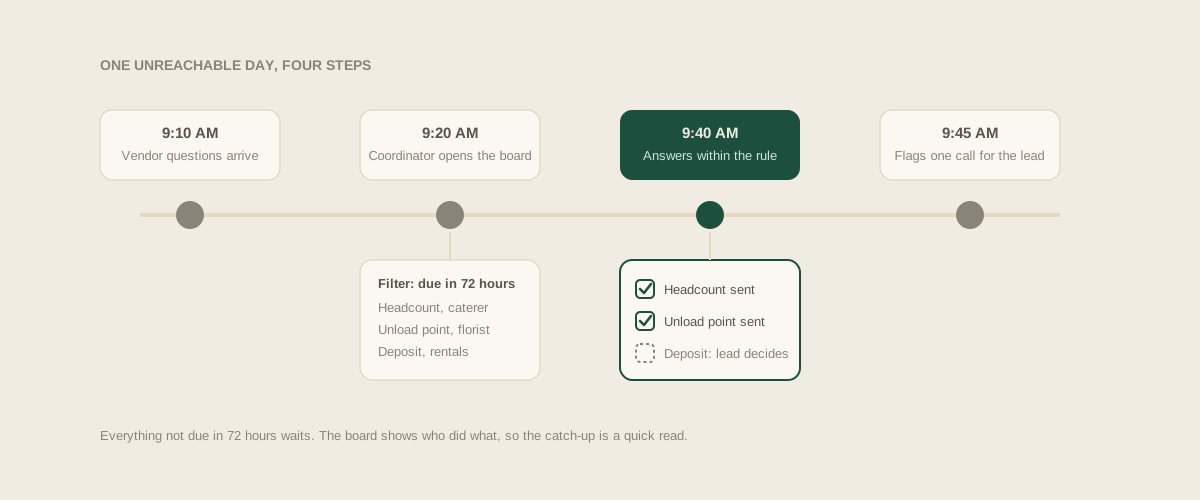
An illness or an emergency is different, because there is no handover. Keep a short routine for it. Someone opens the board for the affected weddings and filters to anything due in the next 72 hours. They message only the vendors with a deadline in that window, using a plain holding line: the planner is out, the team has the file, and here is who to contact.
Everything not due in 72 hours can wait. That boundary matters, because it stops the team from trying to fix the whole season on the worst day.
Close the loop when they return
When the lead planner is back, spend fifteen minutes on a catch-up. What was decided, what was deferred, what needs their call. Because the board shows who did what and when, this is a quick read rather than a long debrief, and nobody has to remember an account of the week.
Where to start
Pick your busiest upcoming wedding and ask one question: if the lead planner vanished tomorrow, what would break first? Fix that one thing, whether it is a missing deadline on the board, a vague approval limit or a backup who has never opened the file. Then repeat for the next wedding.
Frequently asked questions
How quickly should a vendor expect a reply if the lead planner is out?
Set the expectation up front. Most studios commit to a same-day reply from a named backup for anything with a deadline, and tell key vendors who that person is before the absence starts.
What decisions should always wait for the lead planner?
Anything that changes the contract total, swaps a vendor, or makes a promise to the client. Routine confirmations and questions the contract already answers can be handled by a coordinator.
Do we need a backup lead on every wedding?
Yes, but it only counts if that person has been walked through the file. A named backup who has never seen the vendor list is not much of a backup.
How does Glaard help when the lead planner is unreachable?
Everything forwarded to your studio address is read and turned into tasks on the shared board, so deposit dates, final counts and confirmations are visible to the whole team without anyone retyping them.
Get your studio address, free
Get your studio address
