4 Ways Studios Track Custom Orders and Shipments Before the Wedding (And Where One Still Arrives Late)
19 October 2026 · 6 min read
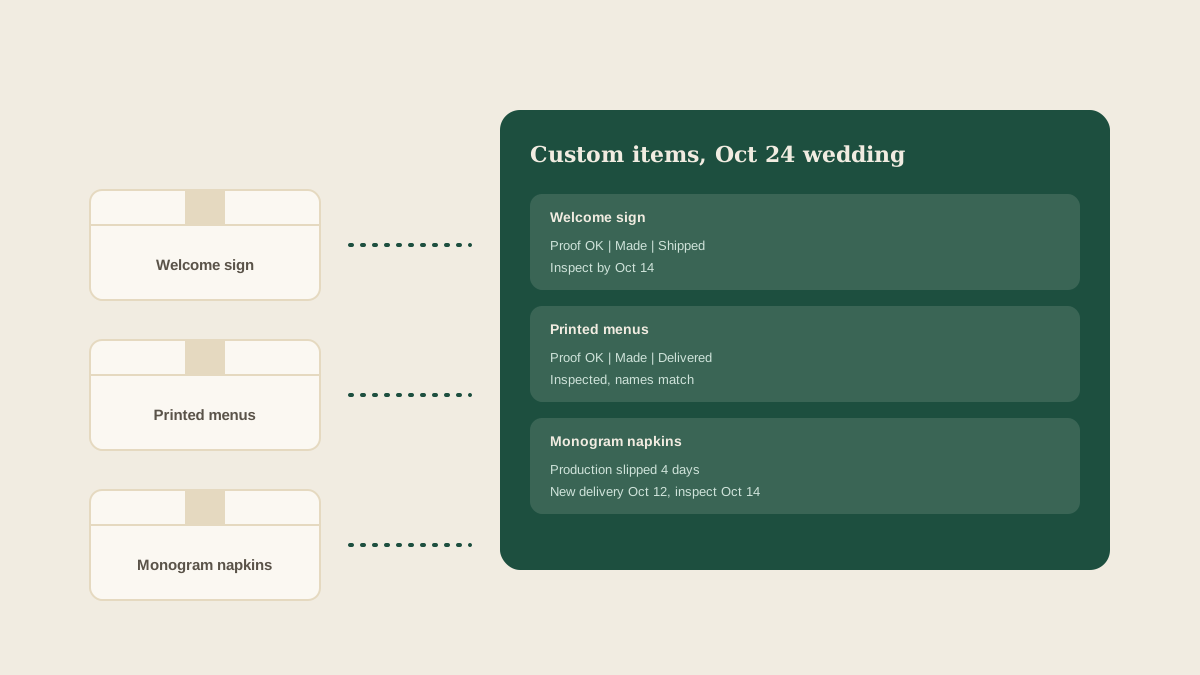
Most of what a vendor brings on the wedding day is booked and scheduled. A surprising amount of it is made first. Custom signage, printed menus, monogrammed napkins, engraved favors, a bespoke arch. Each of these has a production time, a shipping time, a person who needs to be home to sign for it, and a point after which a mistake can no longer be fixed.
That chain is where weddings quietly go wrong. The item is approved, the vendor says it is on the way, and then it is a week before the event and nobody can say where it is. Or it arrives, and nobody opens the box until the morning of the wedding to discover the spelling is wrong.
Here are four ways studios commonly track custom orders and shipments, and the point where each one tends to let something through.
What actually needs tracking
It helps to name the stages, because most trouble comes from tracking only one of them. A custom order moves through approval, production, shipping, delivery, and inspection. Each stage has its own date and its own owner, and a delay in any of them squeezes the one after.
The stage most often missed is the last one. An item that arrived is not the same as an item that has been checked against the order. If nobody is responsible for opening the box and comparing it to the approved proof, the first person to notice an error is a guest.
Way one: the vendor's tracking number in an email
The simplest method is to paste the carrier tracking number into a message or a note and check it occasionally. It tells you where the box is, which is useful, and it costs nothing to set up.
Where it breaks: it covers only the shipping stage. It says nothing about when production should finish, who is receiving the box, or whether the contents are right. And the tracking number lives wherever it happened to land, often in one person's inbox.
Way two: a line in the wedding spreadsheet
Many studios add a row per custom item with an expected delivery date. This is a real improvement, because it puts the items next to everything else for that wedding.
Where it breaks: dates in a spreadsheet are only as fresh as the last time someone updated them. When a vendor emails to say production slipped by four days, that email has to be noticed, read and retyped. In peak season, that step is the one that gets skipped, and the sheet keeps showing a confident, wrong date.
Way three: ask the client to receive and report
Some studios route delivery to the couple or a family member and ask them to confirm arrival. This takes pressure off the team and is sensible when the item is going to the couple anyway.
Where it breaks: clients are busy and are not trained to inspect a vendor's work. "It came, looks nice" is not the same as checking every name and date against the proof. And if the box arrives with no confirmation at all, you only discover that when you ask, usually later than you would like.
Way four: a shared board with a checkpoint per stage
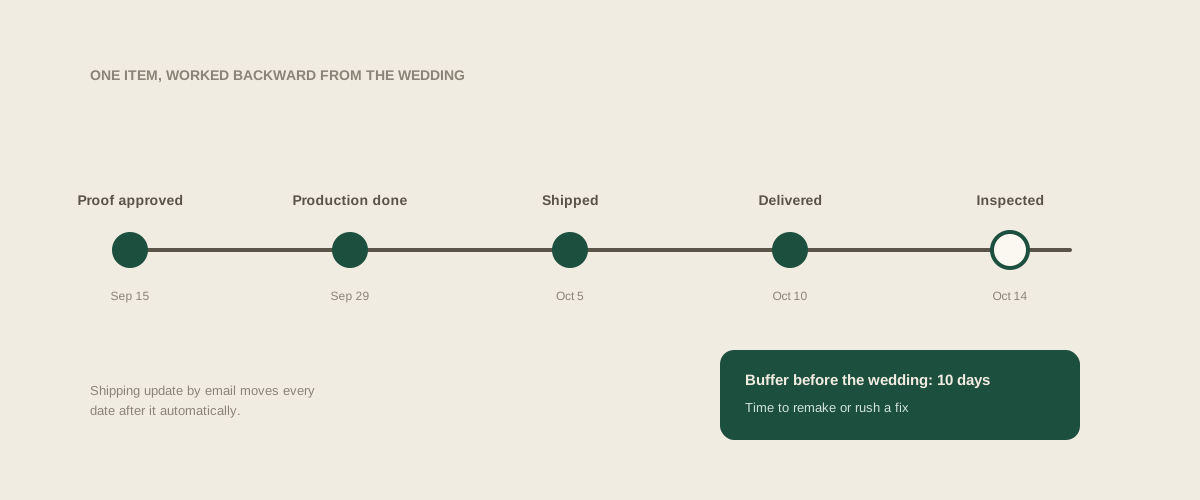
The most reliable approach treats each custom item as a short sequence of dated tasks on the wedding's shared board: proof approved, production complete, shipped, delivered, inspected. Each has a date and a named owner, and the inspection task is due with enough buffer to fix something.
Where it can break: only if the board goes stale. It is the same weakness as a spreadsheet, unless the updates arrive on their own.
This is where forwarding helps. When a vendor emails a production update, a shipping confirmation or a revised delivery date, you forward it to your studio address, and Glaard reads it and moves the matching task on that wedding's board. A message saying "shipping delayed to Thursday" changes the delivery date without anybody retyping it, and the inspection date moves with it.
Work backward from the wedding date
Whatever method you choose, set the dates from the end. Start with the wedding day, subtract a buffer for inspection and repair, then subtract the shipping time, then the production time, then the time the client needs to approve the proof. The result is the real latest date for each step.
Studios often discover this way that a proof needs to be approved far earlier than the client assumes. Telling them that date, with the reason, at the start gets approvals in on time far more reliably than a late reminder.
Decide who inspects, and when
Name a person for the inspection task, not a team. Give them the approved proof to compare against, and a short checklist: names spelled correctly, dates right, quantity matches, nothing damaged, colors close to the approval.
Do this the day the item arrives, not the week of the wedding. If something is wrong, you still have time to ask the vendor for a remake or a rush fix, and you can usually negotiate better when you have raised it early.
Keep a plan B for the items that matter most
Not every item needs a backup, but a few do. Welcome signage and place cards are the usual candidates. For these, ask the vendor for the print-ready file at approval so a local shop can reproduce it in a pinch. It costs nothing to ask, and it turns a lost parcel from a crisis into an errand.
Where to start
Pick your next wedding with a custom item and list its stages with dates, counting backward from the event. Then notice which date currently lives only in someone's inbox. That is the one to put on the shared board first.
Frequently asked questions
How early should custom items arrive before the wedding?
A common target is at least one to two weeks, so there is time to inspect and to get a remake if something is wrong. Work backward from the event and include the vendor's production and shipping times.
Who should receive custom orders, the studio or the client?
Whenever possible, the studio or a named person on the team, since they can inspect against the approved proof. If the client must receive it, ask for photos of the contents the same day.
What if a vendor's production time slips?
Update the delivery and inspection dates immediately, then check whether the remaining buffer is still enough. If not, ask about rush options early, before the window closes.
How does Glaard help track shipments?
Forward vendor production and shipping emails to your studio address, and Glaard turns them into dated tasks on the wedding's shared board, updating delivery and inspection dates when a vendor reports a change.
Get your studio address, free
Get your studio address
