How to Track Vendor Load-Out and Breakdown Times So the Venue Does Not Turn Into a Waiting Room
26 October 2026 · 6 min read
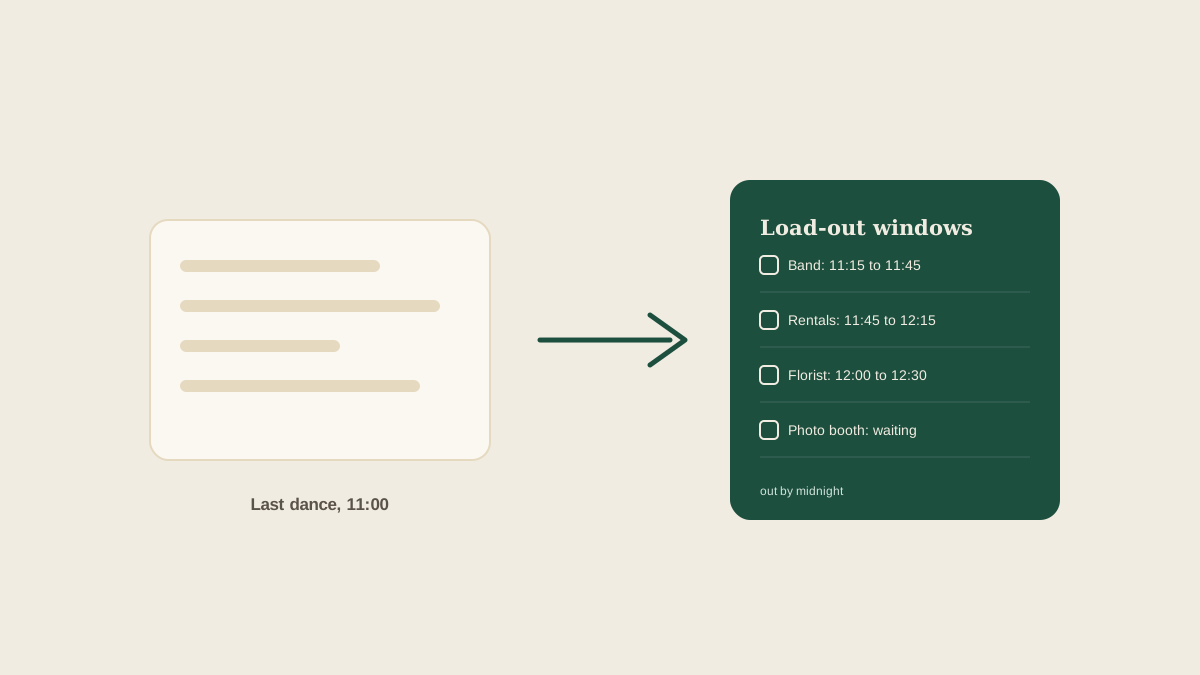
Load-in gets all the attention. Planners build detailed arrival schedules, loading dock rotations, and gate instructions. Then the last song plays, and the plan for the other end of the night is often a vague sense that everyone will clear out sometime before the venue's cutoff.
That vagueness has a cost. Venues commonly charge for every extra half hour past the contracted end time. Rental companies arrive for pickups and find the dance floor still occupied. The band wants to break down while the caterer is clearing tables in the same space. Here is why load-out goes wrong, and how to track it the way you track the morning.
Why load-out is the neglected half
Planning energy follows the first half of the day because that is when problems are visible. If a florist is late in the morning, the whole timeline shifts and everyone notices. If a vendor is vague about their breakdown, nobody notices until the end of the night, when the planner is exhausted and the client is saying goodbye to guests.
Load-out also has more moving parts than people expect. Vendors cannot all leave at once. Sound equipment cannot come down while the last toast is being given. The cake knife needs to go back to the baker, and the rented chairs cannot be collected until the guests are gone. The order matters, and nobody owns it unless someone writes it down.
What a usable load-out plan includes
For each vendor, record the earliest time they may begin breaking down, the latest time they must be out, who is on site to do it, and any dependency, such as 'cannot start until the dance floor is clear.' Include which door or dock they use, since the load-in gate is sometimes closed after dark.
Also record anything left behind on purpose. A florist might leave arrangements for the couple to take, and a rental company might return the next morning. If it is not written, a coordinator will treat a stray item as someone's mistake at one in the morning.
The venue's cutoff is the real deadline
Start from the venue contract. Note when music must end, when guests must leave, and when the space must be completely clear. Then work backward. If the building must be empty at midnight and the band needs forty-five minutes after the last song, the schedule is tighter than the 'end of reception' line suggests.
Many studios discover the overtime clause only after the event, when the invoice arrives. Putting the clear-out deadline at the top of the load-out plan keeps it in view for everyone.
Get each vendor's window in writing
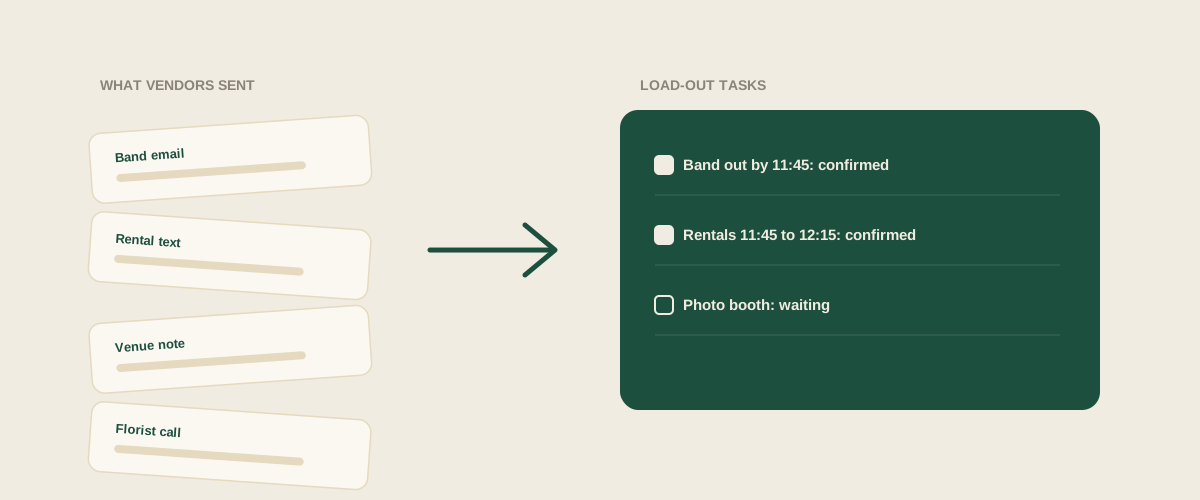
Do not assume a vendor's end time matches the schedule. Ask each one to confirm their breakdown window by email or text. A drummer who says 'we are usually out in thirty minutes' is describing a normal night, not this venue, with its single elevator and its long hallway.
A written reply also gives you something to point to if a vendor is late leaving. And the replies that never come are the useful signal. A silent vendor is a vendor whose end time you do not know.
Assign someone to own the sequence on the night
On the day, one person, usually a coordinator, should hold the load-out order and be authorized to hold a vendor back or release them. Without that, vendors self-organize, which usually means the loudest or the most impatient goes first. Give the coordinator the list, the windows, and the venue's cutoff, and ask them to confirm each vendor out against the written plan.
Handle the vendors who are not obvious
Remember that load-out is not only about the big names. The cake stand, the borrowed lounge furniture, the guest book table, and the ceremony arch all have to leave too, and each belongs to someone. List the small items alongside the vendors, with a name next to each. The things that nobody owns are the ones still sitting in the venue the next morning, and the venue will notice before you do. A short line in the plan, such as who takes the signage and who returns the borrowed frames, costs nothing and prevents a late call from an annoyed venue manager.
Where Glaard fits
Glaard helps with the paperwork around this. Forward each vendor's message about breakdown, the venue's end-time note, or a screenshot of a text to your studio's shared address. Glaard turns it into tasks on the wedding's board, such as 'Band out by 11:45, confirmed,' with the original message attached. A reply that does not give a time shows as waiting.
It does not run the night or decide who leaves first. That judgment belongs to the coordinator on site. What it does is give them a current list built from what vendors actually said, rather than from a note someone wrote three weeks ago.
Where to start
Open the timeline for your next event and check the last two hours. How many vendors have a written breakdown time, and does the total fit inside the venue's cutoff? If the answer is fewer than all of them, start with the vendors who need the most time to pack.
Frequently asked questions
When should load-out times be confirmed with vendors?
Confirm them when you send the final day-of timeline, usually one to two weeks before the event. That leaves time to fix a conflict, such as two vendors needing the same door at the same hour.
What if a vendor needs longer than the venue allows?
Raise it early. Options include an extra hour on the venue contract, a staggered departure, or having the vendor return the next morning for equipment that is not time sensitive. Each is easier to arrange before the day than during it.
Who should decide the order vendors load out?
The lead planner should set the order in advance, and the on-site coordinator should be authorized to adjust it. Dependencies matter: sound cannot come down during the last event of the night, and rentals cannot be collected from an occupied floor.
How does Glaard help with load-out times?
Forward vendor replies, venue notes, and text screenshots to your studio address. Glaard turns them into tasks on the shared wedding board, marked confirmed or waiting, so the coordinator can see which vendors have an agreed breakdown window.
Get your studio address, free
Get your studio address
