4 Ways Studios Handle Vendor Overtime on the Wedding Day (And Where the Extra Charge Still Goes Unapproved)
12 October 2026 · 6 min read
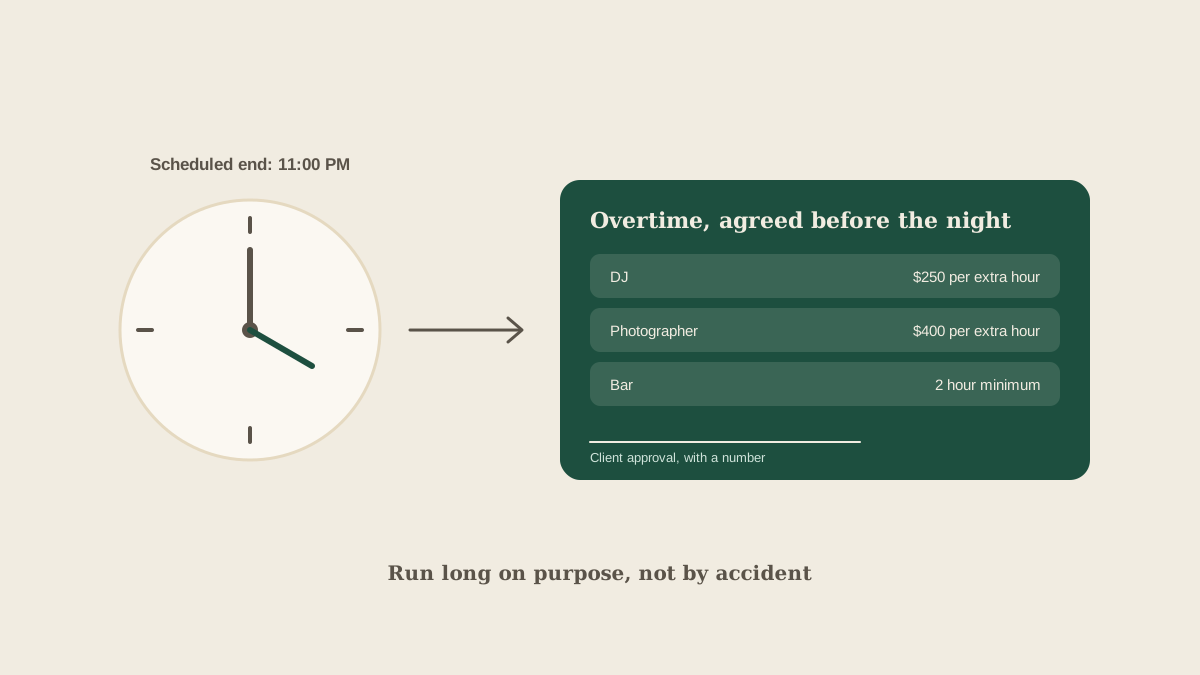
Almost every vendor contract has an overtime clause, and almost nobody reads it until the night it applies. The DJ's agreement says $250 per additional hour after 11 PM. The photographer's says $400 per hour, billed in half-hour increments. The bartending company charges per bartender, per hour, with a two-hour minimum once the bar runs past its scheduled close.
On the day, the decision to run long is usually made in about ten seconds, by a client at the edge of the dance floor who says "can we keep going?" The planner says yes because the room is happy. Three weeks later the final invoices arrive and four vendors have billed for time that nobody wrote down. Here are four ways studios try to handle this, and where each one still lets an unapproved charge through.
1. Tell the vendors to just keep going and sort it out later
This is the default. The room is full, the energy is good, and stopping the music to discuss rates would be absurd. So the planner nods, the vendors keep working, and everyone assumes the billing will be reasonable.
It works right up until the invoice. Without a record of who approved the extra time, the vendor's version of events is the only one on paper. The client says they never agreed to the third hour. The vendor says the planner told them to continue. The studio is now in the middle, and the usual outcome is that the studio absorbs part of the difference to keep the relationship intact.
2. Rely on the contract's overtime clause
The next step up is to point at the contract. If the clause says $250 per hour, the thinking goes, the rate is already agreed and no further approval is needed.
The rate is agreed. The decision to incur it is not. A contract tells you what an hour costs, not whether this client wanted to spend $1,000 on four extra hours across four vendors. It also does not tell you which vendors will actually bill for it, because some quietly waive the first thirty minutes and others round up. And the clauses are scattered across a dozen contracts in different formats, so nobody has the full picture of what an extra hour costs the client in total until the night is over.
3. Get a verbal yes from the client on the night
Some planners are careful to ask. They find the client or the client's parent during the evening, say "the band wants to know if we're extending," and get a yes.
This is better, and it still leaves a gap. A verbal yes has no number attached. The client agreed to "a bit longer," and the planner has no way to show later that they were told the cost. If the person who said yes was the bride's father but the bill goes to the couple, the question of who approved what becomes personal. And the vendor may never hear the instruction at all. The planner tells the client, the client says yes, and the second shooter packs up at 11 anyway because nobody told them.
4. Settle the overtime rates and the approval rule before the day
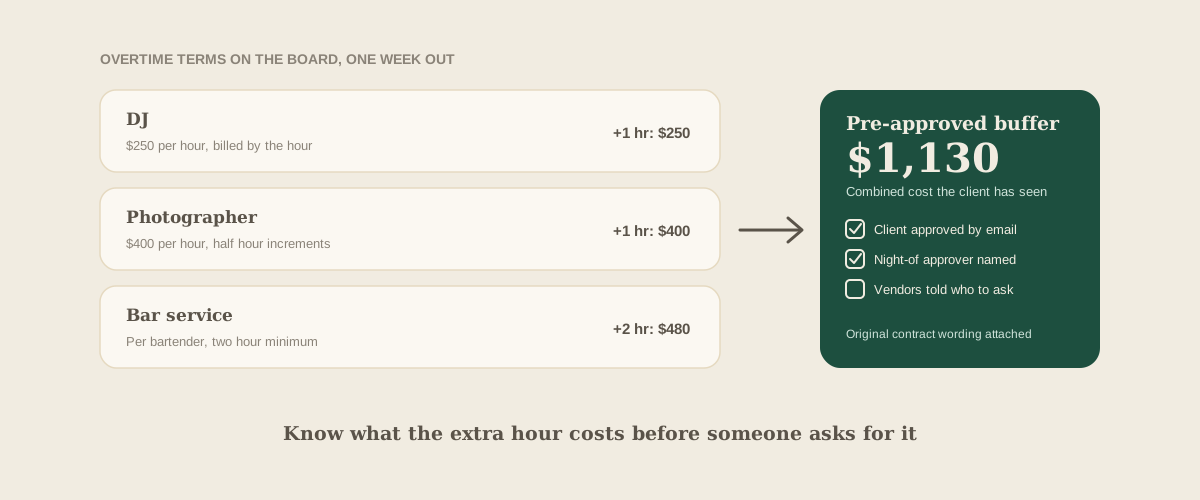
The fourth approach moves the whole conversation earlier. Before the event, every vendor's overtime terms go onto the shared board: the rate, the increment, the minimum, and whether it needs the client's sign-off. Glaard builds that from the contracts and emails the studio forwards to its shared address, so the overtime clause shows up as a task on the vendor, with the original wording attached.
The planner then sits down with the client once, a week or two out, and agrees two things. First, a pre-approved buffer, such as up to one extra hour across all vendors at a combined cost the client has seen. Second, who on the day can approve more, with a phone number. On the night, the decision is no longer improvised. If the room wants to go past the buffer, the planner has a number to quote and a person to ask.
It does not remove the judgment. Somebody still has to read the room, and some vendors will not extend at all, because they have another booking in the morning. But when the DJ asks whether he can keep going, the answer is a quick look at the board, not a guess.
What to record on the night
Whichever method you use, three details are worth writing down while they are fresh: the time the extension was agreed, who agreed to it, and which vendors were told. A message to the studio address from the planner's phone is enough. "Client approved one extra hour at 10:40, DJ and bar notified, photographer already left" becomes a dated note on each vendor's task, which is exactly what you will want when the invoice arrives.
Then match the invoices to the notes. If the DJ bills for two extra hours and the note says one, you have a conversation with evidence instead of a recollection.
Close the loop before the final balance
Overtime tends to surface in the last invoice, after the final balance has been scheduled. Add a task for each vendor to confirm the overtime total before the final payment goes out, with the note from the night attached. It is a five-minute check that prevents a refund request six weeks after the wedding.
Where to start
Pick your next wedding and open the DJ and bar contracts. Find the overtime clause in each and write the hourly cost on one line. Add them up. If the number surprises you, it will surprise the client, and that is a conversation to have this week, not at 10:45 on the night.
Frequently asked questions
Should the client pre-approve overtime in writing?
Yes, ideally with a number. A short email that says "up to one extra hour across vendors, around $900 total" is enough. It gives you something to point to and gives the client a chance to say no before the night.
Who pays if the planner extends a vendor without asking the client?
That depends on your own contract with the client, but in practice the studio often ends up covering a disputed amount. The cleanest protection is a pre-agreed buffer and a named person who can approve more on the day.
What if a vendor does not want to extend?
Ask early. Put the question to each vendor a week before, and note on the board who can stay and who cannot. Learning at 10:55 that the photographer leaves at 11 is much harder to fix than knowing it in advance.
How do we avoid arguing about overtime on the final invoice?
Keep a dated note for each extension, with the time, who approved it, and which vendors were told. Compare each final invoice to those notes before paying the balance, and raise any difference while the details are still fresh.
Get your studio address, free
Get your studio address
