How to Track Permits and Venue Approvals So a Missing Form Does Not Stop the Wedding
29 October 2026 · 6 min read
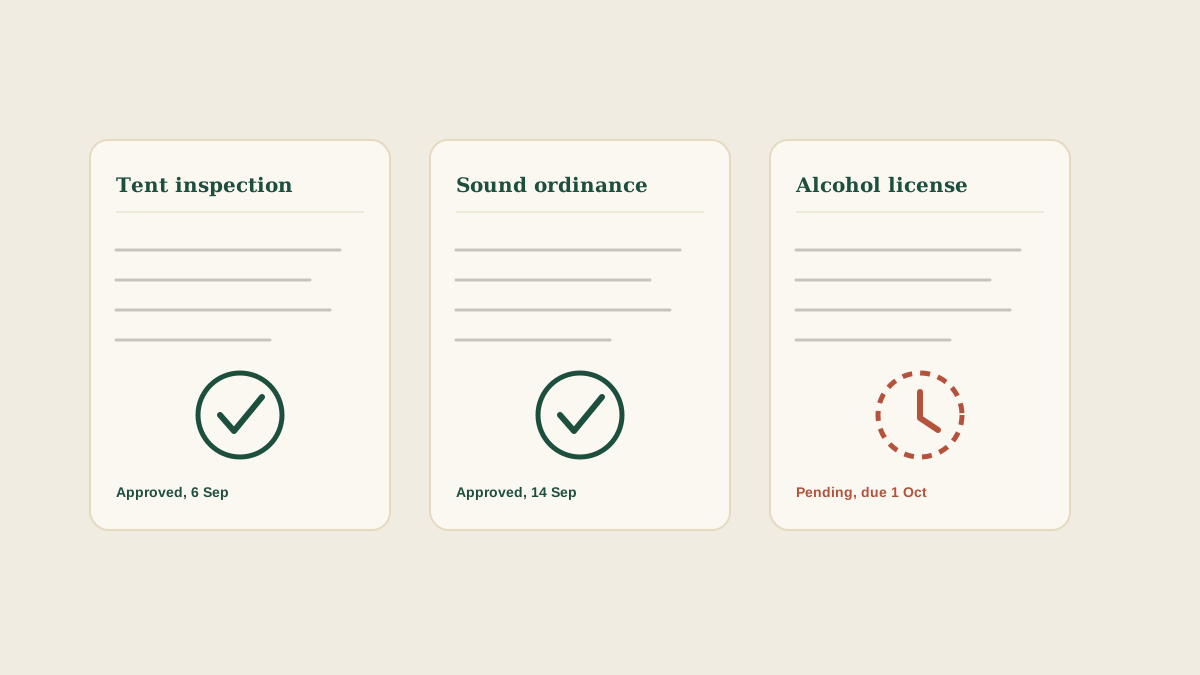
Most of the paperwork around a wedding is invisible until it is missing. The tent company needs an inspection sign-off. The venue wants a copy of the bartender's alcohol license. The city has a sound ordinance that ends the band at 10 pm. The fireworks vendor needs a permit that takes three weeks. None of these is hard on its own. The trouble is that each one has a different owner, a different lead time, and a different person who has to say yes.
Permits and approvals also fail quietly. A late deposit shows up on an invoice. A missing permit shows up on the wedding day, when an inspector or a venue manager is standing in front of the tent. Here is how to track them so they get the same attention as the florist and the caterer.
Start with a list of what this wedding actually needs
Requirements vary by venue, city and what the couple has planned. A backyard wedding with a tent and a food truck needs a very different set of approvals than a ballroom. Before anything else, write down which of these apply: tent or structure permits, amplified sound limits, alcohol service rules, open flame or fireworks, street or parking closures, temporary power, and any venue insurance requirements.
The venue coordinator is the fastest source for this. Ask a direct question: what do vendors need to submit, to whom, and by when? Get the answer in writing so you are not relying on a phone call.
Separate who files from who needs the result
A permit has two people attached to it. One person files it, and one or more people depend on the outcome. The tent company may file the inspection request, but the venue wants proof, and the couple wants to know it will not block the aisle. If you only track that it was filed, you miss the part where the proof has to reach the venue.
For each approval, note the filer, the approver, and every party that needs a copy. That one line prevents most of the later confusion about whose job it was.
Work backward from the lead time
The most useful number on any permit is not the cost. It is how far ahead it has to be filed. Some approvals take a day, others take a month, and some only accept applications during a narrow window.
Pick the wedding date, subtract the lead time and add a buffer, and put the result on the board as the real due date. A fireworks permit that takes 21 days is due on day 30, not the week before. Do this at booking, not when the permit comes up in conversation.
Get the paperwork out of inboxes
Permit information usually arrives in awkward forms: a PDF from the city, a reply from the venue manager, a photo of a license on a bartender's phone. These tend to sit in whoever's inbox received them.
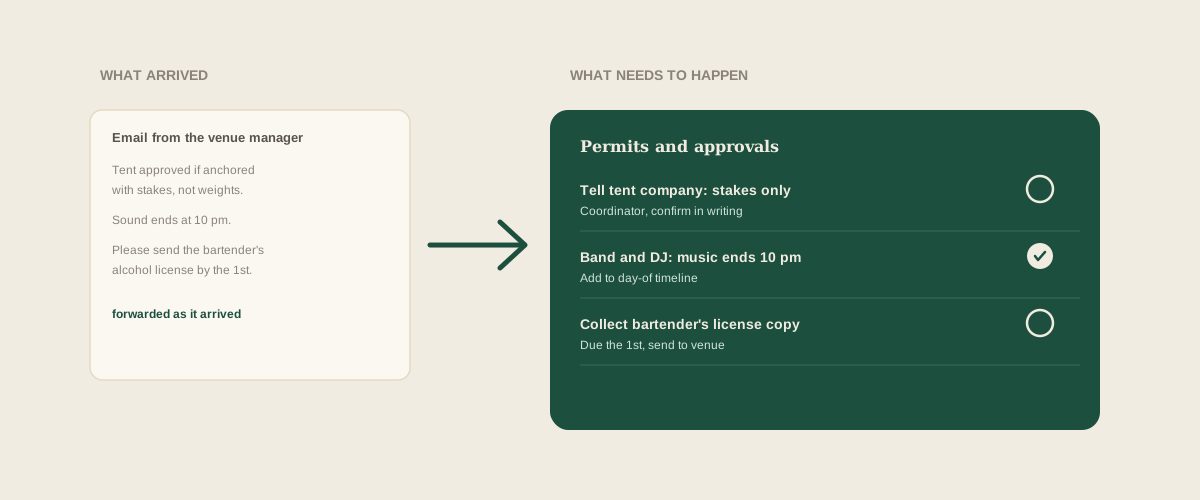
Forward each one to your studio address. Glaard reads the message, works out which wedding it belongs to, and turns it into tasks on the wedding's shared board: submit the tent inspection form, confirm the sound cutoff with the band, collect the alcohol license copy for the venue. The original email or attachment stays with the task, so anyone on the team can see what the approver actually said.
Track the state, not just the existence
A permit is rarely just done or not done. It is requested, submitted, under review, approved, or approved with conditions. Conditions are where surprises hide: approved as long as the tent is anchored with stakes rather than weights, or approved until 10 pm.
Add the conditions as their own tasks. If the approval says no amplified sound after 10 pm, that is a task for the band, the DJ and the day-of timeline, not a line buried in a PDF. Each affected vendor should hear it from you, and confirm they have.
Share the answer with every vendor it touches
An approval that stays with the planner does not protect anyone. The caterer needs to know whether open flame is allowed for a chafing station. The photographer needs to know whether a drone flight was approved. The DJ needs the sound cutoff.
After each approval, list which vendors it affects and send the relevant line, not the whole document. Ask for a short reply confirming they have seen it. Forward the reply so it attaches to the task.
Keep copies where the day-of team can find them
On the wedding day, an inspector or a venue manager may ask to see a document. The person who filed it may be at the ceremony, not in the loading area. The coordinator on site should be able to pull up the approval in a few seconds.
Because each approval is attached to a task on the board, the day-of coordinator reads it there instead of searching someone's email. If your team prints a day-of binder, add a page for permits and approvals so nothing depends on a phone signal.
Review at one week out
A week before the wedding, scan the board for any approval that is not marked as received. Anything still pending is a decision: chase it, find a workaround, or tell the couple early. A week is enough time to move a tent or change the plan. The day before is not.
Where to start
Pick your next wedding with an outdoor space, a tent or a late-night plan. Ask the venue what approvals it needs, work out the real due date for each, and put one task per approval on the board with a filer and a recipient. After that, each new requirement becomes a line you can see, instead of something you hope somebody remembered.
Frequently asked questions
Which permits and approvals do wedding studios usually have to track?
It depends on the venue and city, but common ones are tent or structure inspections, amplified sound limits, alcohol service licenses or insurance, open flame or fireworks permits, street or parking closures, and drone flight approvals. Ask the venue coordinator what applies and get the list in writing.
How early should permit applications be filed?
Work backward from the lead time the approver gives you, then add a buffer. A permit that takes three weeks should be filed at about a month out. Put that date on the board as the real due date as soon as the wedding is booked.
What if an approval comes with conditions?
Treat each condition as its own task and assign it to the vendor it affects. A sound cutoff goes to the band and DJ, an anchoring requirement goes to the tent company. Ask each one to confirm in writing.
How does Glaard help with permits and approvals?
Forward the permit email, form or license photo to your studio address. Glaard reads it and creates tasks on the wedding's shared board for each filing, condition and copy still needed, with the original message attached.
Get your studio address, free
Get your studio address
