4 Ways Studios Collect Vendor W-9s and Payment Details Before the Final Balance (And Where One Still Goes Missing)
2 November 2026 · 6 min read
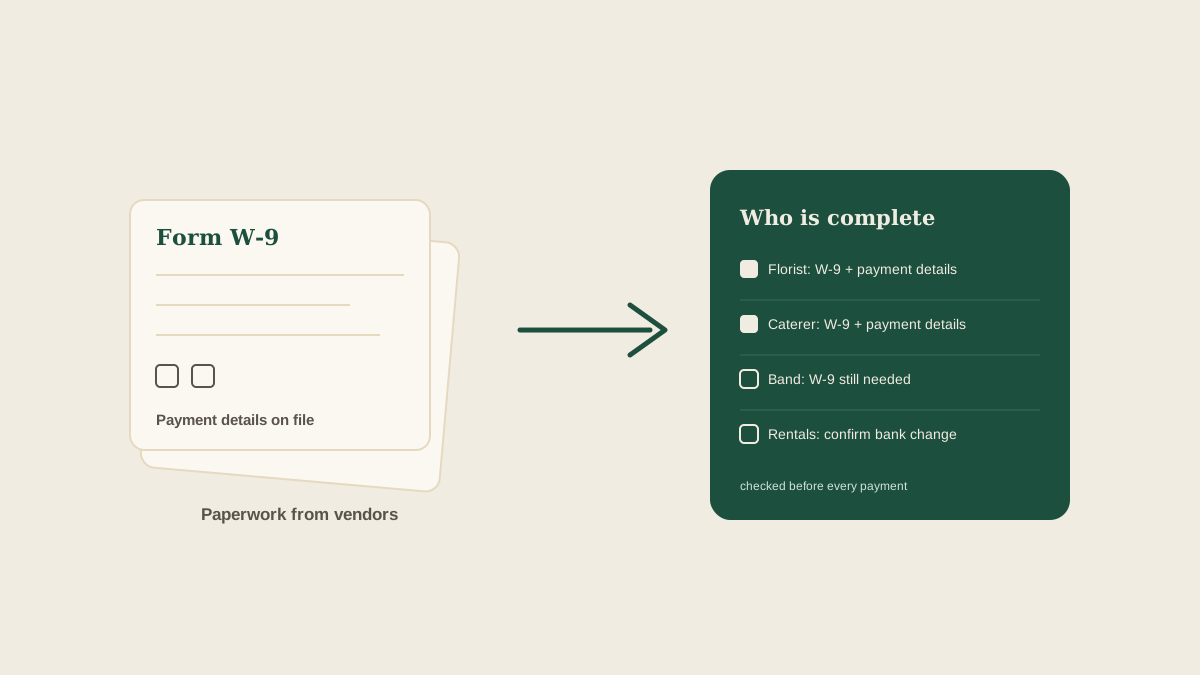
Most of the vendor paperwork in a wedding is about the wedding: contracts, timelines, insurance certificates. Then there is the paperwork that is about getting paid. A W-9 for the tax file. The right name on the invoice. Bank details, or the right link for the payment portal. None of it feels urgent in month two. All of it becomes urgent on the afternoon the final balance is due.
When a studio handles payments on a client's behalf, or simply needs clean records for the year end, this paperwork needs an owner. The usual failure is not that nobody cares. It is that each document arrives in a different place, from a different person, at a different time, and nobody has a single view of who is complete.
Here are four ways studios try to collect it, and where each one still leaves a vendor half-finished.
1. Ask for everything at booking
The tidiest approach is to request the W-9, the payment details and the correct billing name the moment a vendor is booked. If the vendor sends them promptly, the whole problem disappears.
Where it breaks: booking is also the busiest moment for the vendor, and a request buried in a welcome email gets lost. Some vendors answer half of it (the W-9 but not the payment method). A few never answer at all, and because the request was made months ago, nobody remembers to ask again until the balance is due.
2. Collect it in a form
Some studios send a short form that asks for the legal business name, tax classification, mailing address and preferred payment method. It is more consistent than a pile of emails, and it gives the vendor one thing to do.
Where it breaks: a form only records what the vendor submitted. It does not tell you who has not submitted it, and it does not catch the vendor who replies by email instead because that was easier. You still need a second list to know who is outstanding.
3. Let the bookkeeper chase it
Other studios hand the job to their bookkeeper, who knows exactly what is needed and when. The paperwork gets requested at the point of payment, which keeps the studio out of it until something is wrong.
Where it breaks: the bookkeeper sees the vendor at the moment of payment, which is the worst time to discover a gap. By then the vendor is waiting on money, the planner is being asked what happened, and the original contact for that vendor is a person the bookkeeper may never have spoken to.
4. Keep a spreadsheet of who has sent what
A tracking sheet with one row per vendor and a column for each document is the most common compromise. It gives you an overview and it is easy to share.
Where it breaks: someone has to update it. A W-9 arrives as an attachment in one coordinator's inbox, a corrected bank detail comes by text, and the sheet shows a blank next to a vendor who actually sent everything last Tuesday. Over a season the sheet drifts from reality, and people stop trusting it.
What actually works: a request, an owner and a date
Across all four methods the missing ingredient is the same. Each document needs to exist as a task with a name on it and a date, not as a hope that the vendor will reply. If you ask a vendor for a W-9, there should be a task that says "W-9 from the florist, requested on the 3rd, follow up if not received by the 17th, owned by the coordinator".
When the document comes in, the task closes with the attachment on it. When it does not, the task is visibly overdue, long before the final balance.
Pulling it off the inbox automatically
The painful part is that these documents arrive wherever the vendor happens to send them. Glaard handles that by reading what you forward to your studio address: the email with the attached W-9, the message with the updated payment details, even a screenshot of a text. It turns each one into a task or ticks off an existing one, on the wedding's shared board with the original message attached.
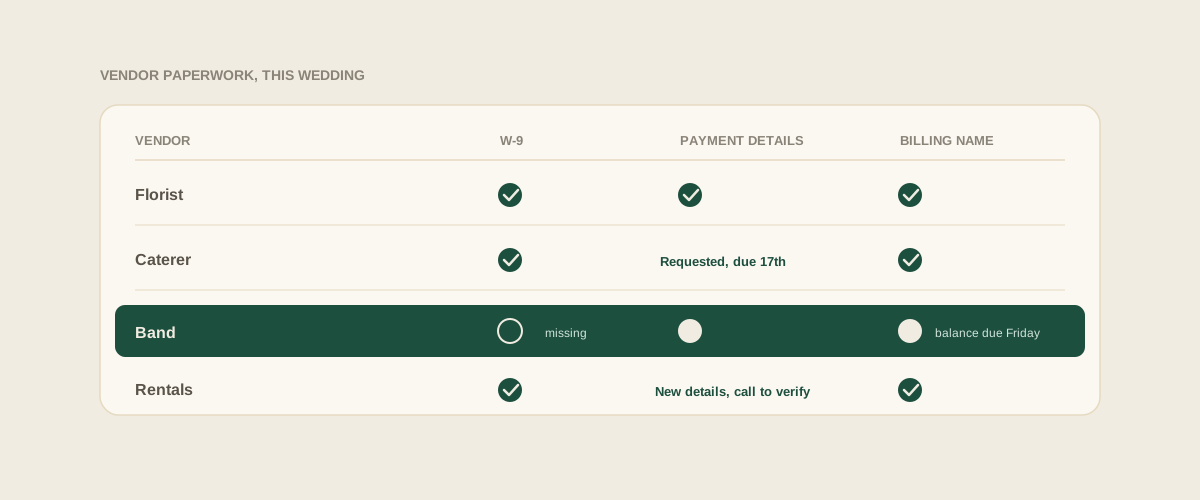
That means the coordinator who received the paperwork does not need to update a sheet, and the person preparing the payment can see at a glance which vendors are complete and which still owe something.
Treat changed payment details with extra care
One category deserves its own rule: a vendor who sends new bank details after the first set was on file. This is a common pattern in payment fraud, so a change should never be accepted from an email alone.
Make it a task with a verification step. Someone calls the vendor on the number already in the contract and confirms the change verbally before the new details are used. Attach a short note that says who confirmed and when. It adds five minutes and removes a real risk.
Check before each payment, not after
A good habit is to look at the paperwork status when a payment is scheduled, not when it is released. A weekly glance at the vendors with a payment due in the next two weeks, and which of them are incomplete, turns a last-minute scramble into a routine follow-up.
Where to start
Pick the wedding with the next final balance due. List each paid vendor and mark which of the three items (W-9, payment details, billing name) are confirmed. Every blank is a task with an owner and a follow-up date. Do that once, and you will see how much of this was riding on memory.
Frequently asked questions
When should a studio ask vendors for a W-9?
Ask at booking, then treat it as a task with a follow-up date rather than a one-off request. If it has not arrived a few weeks before the first payment is due, chase it then, not on the day the money is supposed to go out.
Should payment details be collected by email?
It is better to use a form or a secure portal where you can, but many vendors will reply by email regardless. Whatever the channel, record it as a task with the original message attached, and verify any change to bank details by phone.
Who should own vendor paperwork, the planner or the bookkeeper?
The studio should own the collection, because the planner or coordinator is the one with the vendor relationship. The bookkeeper then works from a list that is already complete instead of discovering gaps at payment time.
How does Glaard help with vendor payment paperwork?
Forward vendor emails, attachments and screenshots to your studio address. Glaard reads them and turns requested documents, received paperwork and changed payment details into tasks on the wedding's shared board, with the original messages attached.
Get your studio address, free
Get your studio address
